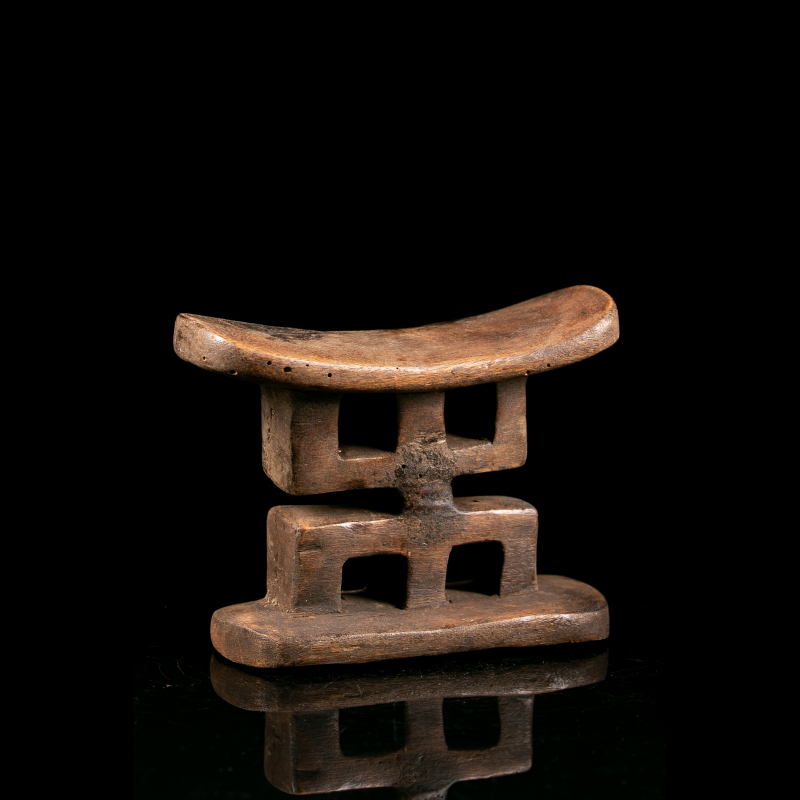
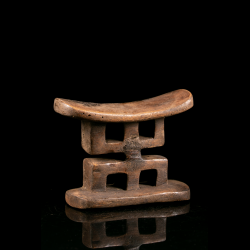
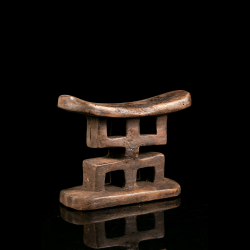
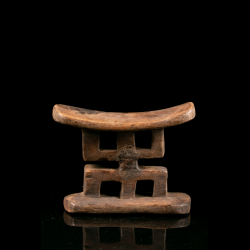
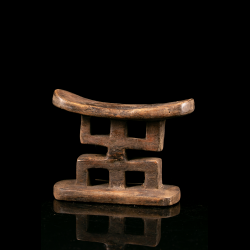
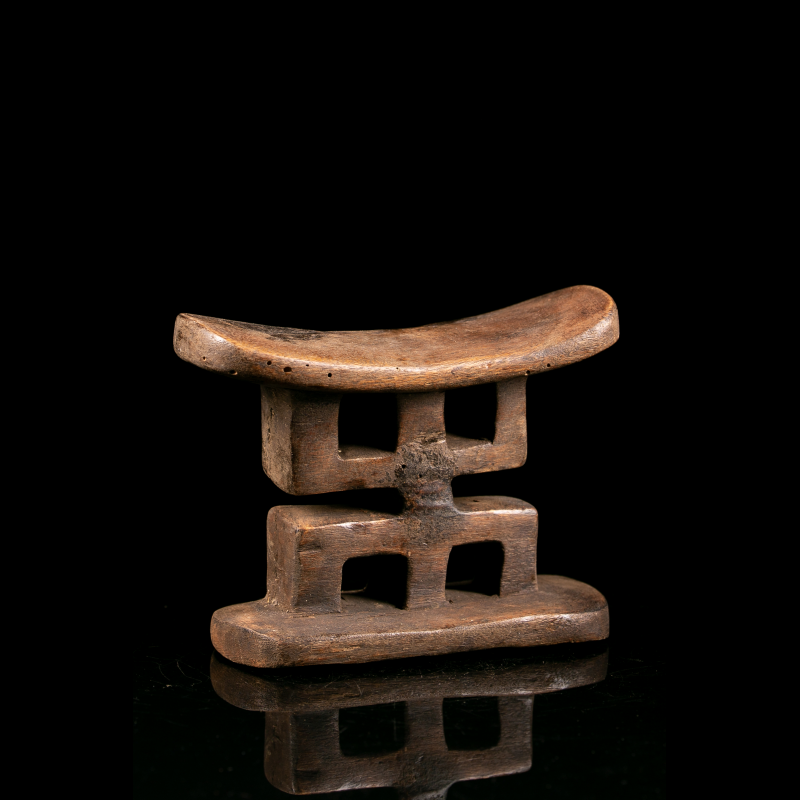
The strength of this Mfinu headrest lies in the remarkable economy of its design. Ornament has been reduced to a minimum, allowing the sculpture to depend entirely upon proportion, negative space and the interaction of curved and rectilinear forms. A long, gently concave neck support crowns an openwork structure arranged on two levels, above an elongated base that gives the composition exceptional visual balance.
Such radical simplification is particularly relevant to documented Mfinu headrests, whose sculptural language can reduce the human form to highly abstract geometric planes. In the present example, four rectangular openings divide the supporting structure while a narrow central junction creates a strong vertical axis. The result is almost architectural: solid wood and empty space are given equal importance.
Despite its sculptural quality, the object belongs to an intimate category of functional furniture. Headrests were designed to support the head or neck while sleeping and, in many African communities, helped protect elaborate hairstyles. Their significance could also extend beyond physical comfort to ideas of personal identity and social standing.
The wood displays warm brown tonal variations, with lighter areas along surfaces naturally exposed to handling and contact. Particularly attractive is the contrast between the gently curved upper support and the rigorous geometry of the openwork base.
With its restrained design, carefully balanced proportions and striking use of negative space, this Mfinu headrest has the presence of a small abstract sculpture while retaining the clarity of its original functional form.
Provenance :
Aimé-Lucien Mbungu Mbuka is a respected Congolese expert, antiquarian, and collector specializing in ethnic and tribal art. Founder of the Antika Gallery at the Boboto Cultural Centre in Kinshasa, he has worked for more than thirty years to preserve and promote Congo’s traditional artistic heritage.
As President of the National Association of Antiquarians of Congo (ASSONACO), he emphasizes the historical, spiritual, and cultural significance of African masks, sculptures, and ritual objects. He is also involved in discussions surrounding the restitution of African heritage held abroad.
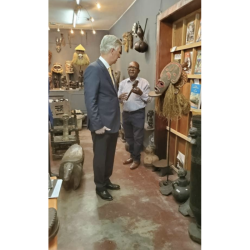
In June 2022, King Philippe of Belgium visited the Antika Gallery, where Mbungu Mbuka introduced him to various aspects of traditional Congolese art. He also published One Hundred Congolese Sculptures from the Antika Collection in 2009 and continues to promote Congolese art both in the DRC and in Europe.
Data sheet
You might also like
The strength of this Mfinu headrest lies in the remarkable economy of its design. Ornament has been reduced to a minimum, allowing the sculpture to depend entirely upon proportion, negative space and the interaction of curved and rectilinear forms. A long, gently concave neck support crowns an openwork structure arranged on two levels, above an elongated base that gives the composition exceptional visual balance.
Such radical simplification is particularly relevant to documented Mfinu headrests, whose sculptural language can reduce the human form to highly abstract geometric planes. In the present example, four rectangular openings divide the supporting structure while a narrow central junction creates a strong vertical axis. The result is almost architectural: solid wood and empty space are given equal importance.
Despite its sculptural quality, the object belongs to an intimate category of functional furniture. Headrests were designed to support the head or neck while sleeping and, in many African communities, helped protect elaborate hairstyles. Their significance could also extend beyond physical comfort to ideas of personal identity and social standing.
The wood displays warm brown tonal variations, with lighter areas along surfaces naturally exposed to handling and contact. Particularly attractive is the contrast between the gently curved upper support and the rigorous geometry of the openwork base.
With its restrained design, carefully balanced proportions and striking use of negative space, this Mfinu headrest has the presence of a small abstract sculpture while retaining the clarity of its original functional form.
Provenance :
Aimé-Lucien Mbungu Mbuka is a respected Congolese expert, antiquarian, and collector specializing in ethnic and tribal art. Founder of the Antika Gallery at the Boboto Cultural Centre in Kinshasa, he has worked for more than thirty years to preserve and promote Congo’s traditional artistic heritage.
As President of the National Association of Antiquarians of Congo (ASSONACO), he emphasizes the historical, spiritual, and cultural significance of African masks, sculptures, and ritual objects. He is also involved in discussions surrounding the restitution of African heritage held abroad.
In June 2022, King Philippe of Belgium visited the Antika Gallery, where Mbungu Mbuka introduced him to various aspects of traditional Congolese art. He also published One Hundred Congolese Sculptures from the Antika Collection in 2009 and continues to promote Congolese art both in the DRC and in Europe.