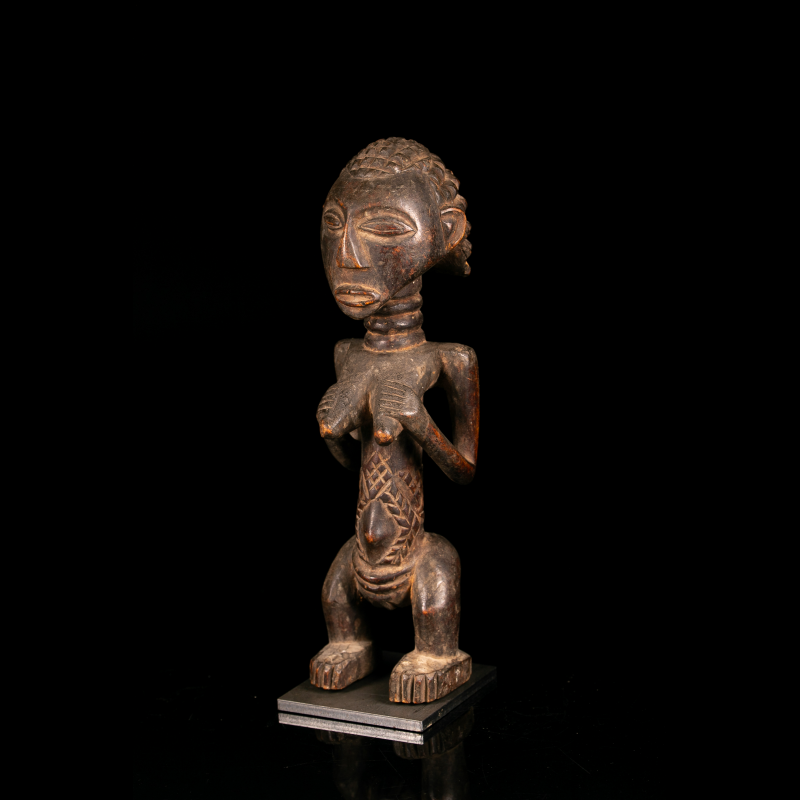
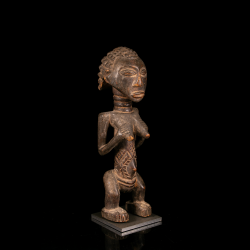
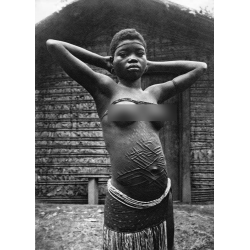
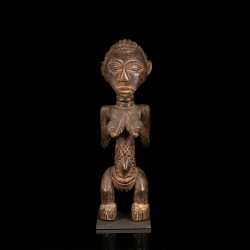
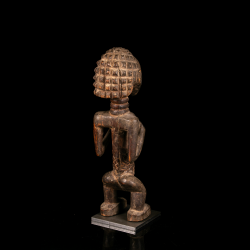
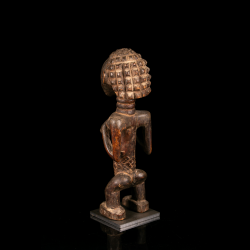
This important Luba female figure displays a powerful, hieratic construction: flexed legs, large firmly planted feet, an elongated torso and a deliberately oversized head. The hands brought toward the breasts form one of the most emblematic gestures in Luba female sculpture. The face, with almond-shaped eyes and projecting lips, is crowned by a particularly elaborate coiffure, deeply carved at the back. The ringed neck and geometric scarification patterns across the abdomen further evoke a woman of elevated social standing.
Female imagery occupies a central position in Luba political thought. Women at court could serve as advisers, dignitaries, ambassadors and spirit mediums; more fundamentally, the female body was understood as a privileged vessel for spiritual power and for the continuity of sacred kingship. The hands-to-breasts gesture therefore refers less to maternity in a literal sense than to transmission, royal secrets and the bizila, prescriptions and prohibitions entrusted to women. The Smithsonian documents closely comparable Luba figures and specifically discusses this gesture.
The sculpture thus belongs to the broader tradition of female imagery associated with Luba authority, also encountered on lupona royal seats, kibango staffs and other insignia of leadership.
Data sheet
You might also like
This important Luba female figure displays a powerful, hieratic construction: flexed legs, large firmly planted feet, an elongated torso and a deliberately oversized head. The hands brought toward the breasts form one of the most emblematic gestures in Luba female sculpture. The face, with almond-shaped eyes and projecting lips, is crowned by a particularly elaborate coiffure, deeply carved at the back. The ringed neck and geometric scarification patterns across the abdomen further evoke a woman of elevated social standing.
Female imagery occupies a central position in Luba political thought. Women at court could serve as advisers, dignitaries, ambassadors and spirit mediums; more fundamentally, the female body was understood as a privileged vessel for spiritual power and for the continuity of sacred kingship. The hands-to-breasts gesture therefore refers less to maternity in a literal sense than to transmission, royal secrets and the bizila, prescriptions and prohibitions entrusted to women. The Smithsonian documents closely comparable Luba figures and specifically discusses this gesture.
The sculpture thus belongs to the broader tradition of female imagery associated with Luba authority, also encountered on lupona royal seats, kibango staffs and other insignia of leadership.