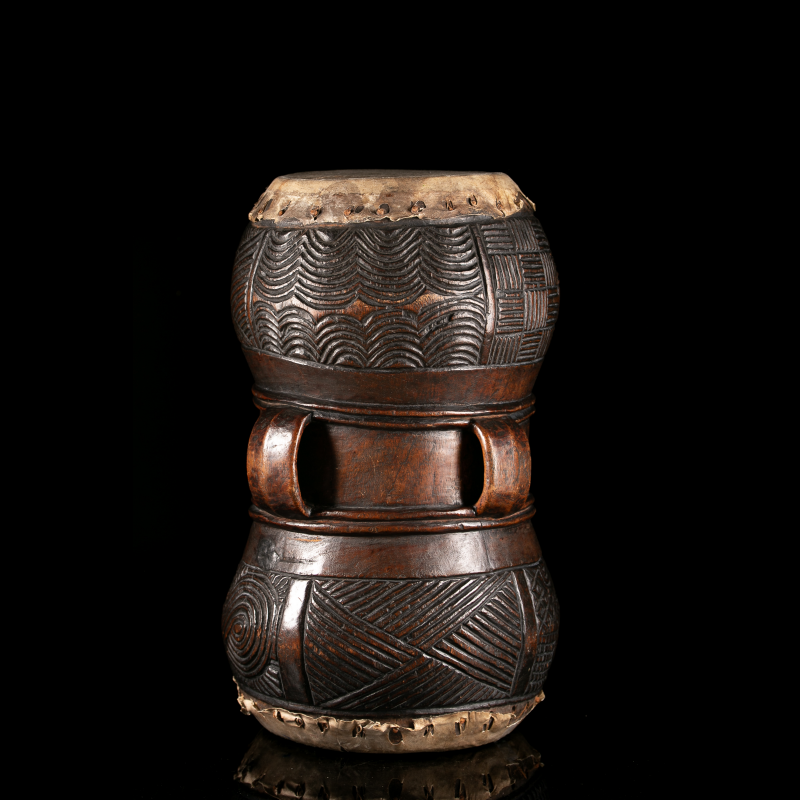
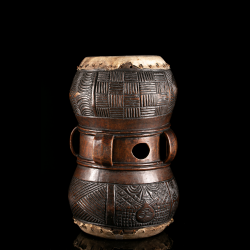
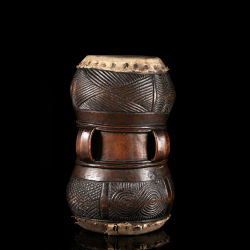
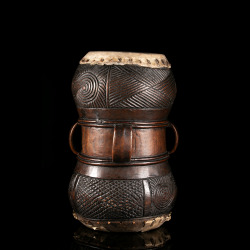
Both a musical instrument and a sculptural work in its own right, this Chokwe mukupela drum is remarkable for the exceptional richness of its decoration. Carved from wood, the body narrows dramatically at the centre, where projecting handles create a strong architectural rhythm and a distinctive silhouette.
Both sections are extensively covered with deeply incised geometric ornament: concentric arcs, interlocking chevrons, grids, spirals and radiating compositions follow one another across the surface. Such elaborate carving reflects the importance given by Chokwe artists to decorated musical instruments. The membranes are stretched over both ends and secured by pegs passing through reinforcing strips of hide, a construction specifically documented for mukupela drums.
Of particular interest is the circular opening in the narrow central section. Ethnomusicological descriptions of the mukupela record a hole in the neck of the instrument associated with an additional vibrating membrane system designed to enrich its sound.
Within Chokwe musical ensembles, mikupela drums were commonly used in pairs. Research by Marie-Louise Bastin records their earlier association with important chiefs as well as their later use as dance instruments. The two heads produced contrasting registers, the deeper end known as shina and the higher-pitched end as songo. Mukupela drums could also participate in ensembles connected with ceremonies surrounding mukanda initiation.
Beyond its musical function, this example has considerable visual presence. The changing geometric registers, deeply carved surfaces and balanced volumes transform the entire body of the drum into a sophisticated sculptural composition.
Data sheet
You might also like
Both a musical instrument and a sculptural work in its own right, this Chokwe mukupela drum is remarkable for the exceptional richness of its decoration. Carved from wood, the body narrows dramatically at the centre, where projecting handles create a strong architectural rhythm and a distinctive silhouette.
Both sections are extensively covered with deeply incised geometric ornament: concentric arcs, interlocking chevrons, grids, spirals and radiating compositions follow one another across the surface. Such elaborate carving reflects the importance given by Chokwe artists to decorated musical instruments. The membranes are stretched over both ends and secured by pegs passing through reinforcing strips of hide, a construction specifically documented for mukupela drums.
Of particular interest is the circular opening in the narrow central section. Ethnomusicological descriptions of the mukupela record a hole in the neck of the instrument associated with an additional vibrating membrane system designed to enrich its sound.
Within Chokwe musical ensembles, mikupela drums were commonly used in pairs. Research by Marie-Louise Bastin records their earlier association with important chiefs as well as their later use as dance instruments. The two heads produced contrasting registers, the deeper end known as shina and the higher-pitched end as songo. Mukupela drums could also participate in ensembles connected with ceremonies surrounding mukanda initiation.
Beyond its musical function, this example has considerable visual presence. The changing geometric registers, deeply carved surfaces and balanced volumes transform the entire body of the drum into a sophisticated sculptural composition.