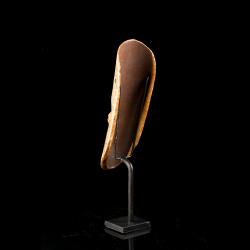
This small Lega mask can very plausibly be identified as a lukungu mask, a category associated with the higher grades of the Bwami initiation society. The Royal Museum for Central Africa records that these small masks, carved from ivory or bone, were displayed around larger idimu masks during initiation ceremonies and embodied the link between the living, accomplished initiates and deceased ancestors.
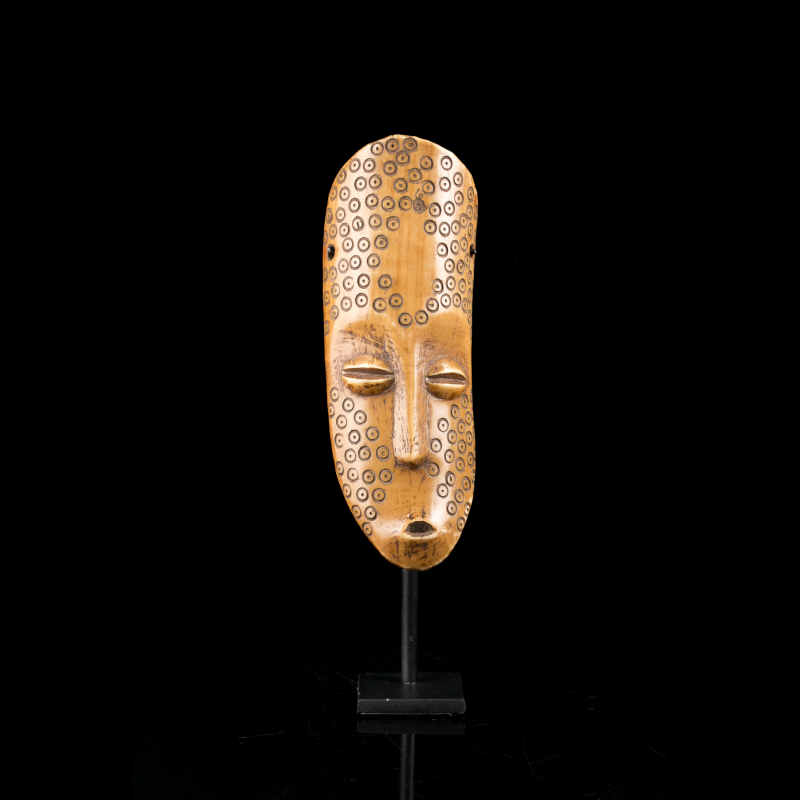
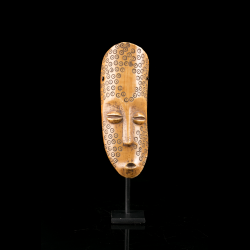
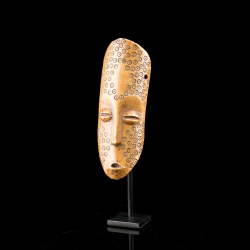
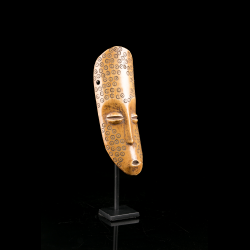
The face is conceived with striking formal restraint: an elongated oval outline, projecting half-closed eyes, a long axial nose and a small open mouth create the meditative expression characteristic of Lega aesthetics. The pale surface is covered with numerous dot-and-circle motifs, a well-documented feature of Lega sculpture referring to body markings and, more broadly, to the ideals of physical beauty and moral refinement promoted through Bwami teachings.
At 17 cm, the mask falls squarely within the documented size range of this type: the Brooklyn Museum preserves an ivory lukungu measuring 16.8 cm, while an example at the Metropolitan Museum measures 18.2 cm.
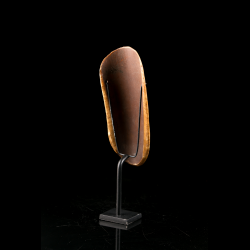
Its finely articulated decoration and warm honey-toned surface give the piece a particularly strong graphic presence. It is offered with the custom-made metal display stand shown in the photographs.
Data sheet
You might also like
This small Lega mask can very plausibly be identified as a lukungu mask, a category associated with the higher grades of the Bwami initiation society. The Royal Museum for Central Africa records that these small masks, carved from ivory or bone, were displayed around larger idimu masks during initiation ceremonies and embodied the link between the living, accomplished initiates and deceased ancestors.
The face is conceived with striking formal restraint: an elongated oval outline, projecting half-closed eyes, a long axial nose and a small open mouth create the meditative expression characteristic of Lega aesthetics. The pale surface is covered with numerous dot-and-circle motifs, a well-documented feature of Lega sculpture referring to body markings and, more broadly, to the ideals of physical beauty and moral refinement promoted through Bwami teachings.
At 17 cm, the mask falls squarely within the documented size range of this type: the Brooklyn Museum preserves an ivory lukungu measuring 16.8 cm, while an example at the Metropolitan Museum measures 18.2 cm.
Its finely articulated decoration and warm honey-toned surface give the piece a particularly strong graphic presence. It is offered with the custom-made metal display stand shown in the photographs.