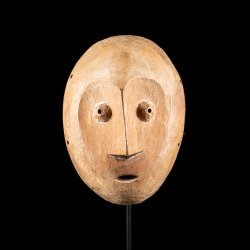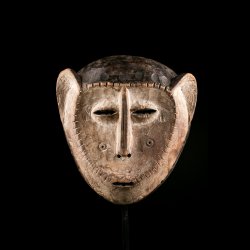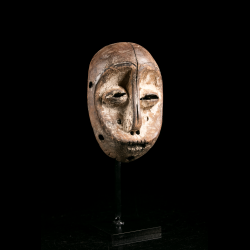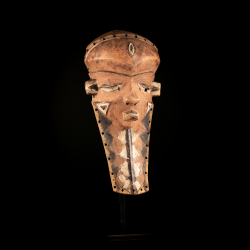
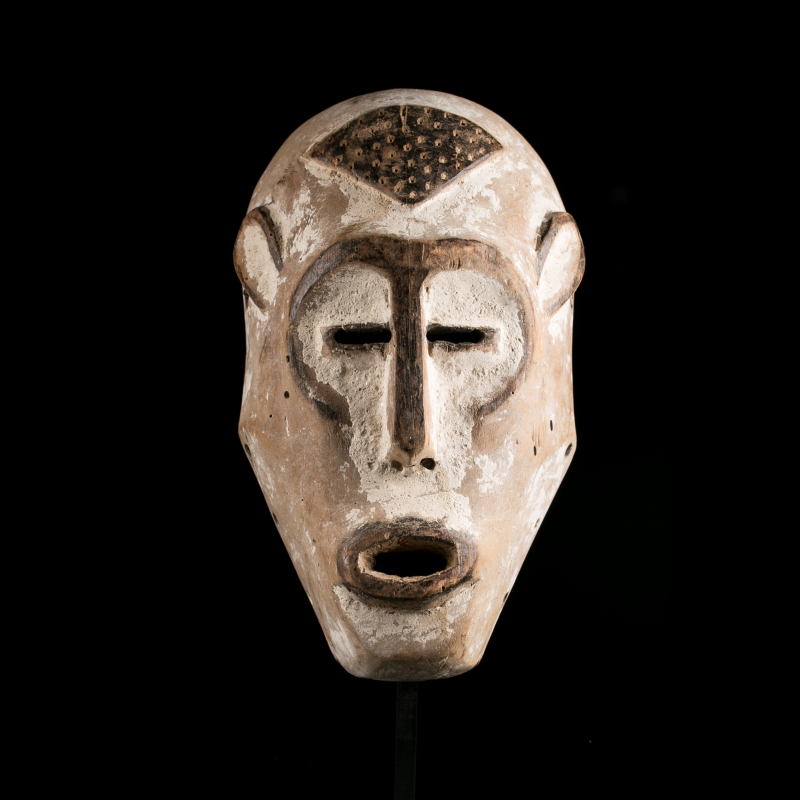
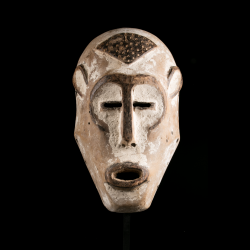
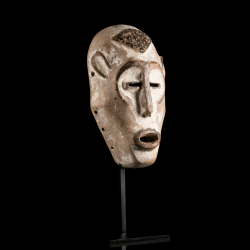
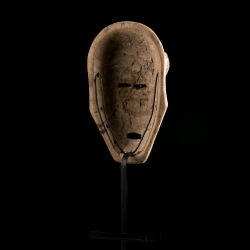
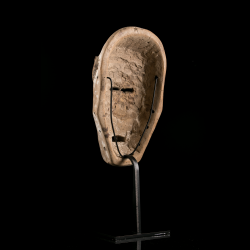
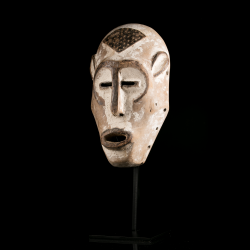
This african Lega mask from the Democratic Republic of Congo stands out through its remarkable blend of human and animal features. The elongated face is defined by narrow slit eyes, a strong nose, and a protruding circular mouth, creating an image that is both human-like and subtly zoomorphic.
White pigments cover much of the surface, contrasting with darker contours that emphasize the sculptural volumes. A triangular motif carved on the forehead adds a symbolic dimension, while the calm, introspective expression gives the mask a timeless and contemplative presence.
Among the Lega people, masks such as this were closely associated with the Bwami society, an initiation system that governed moral, social, and spiritual education. Rather than serving as portraits, these works functioned as visual teachings, embodying wisdom, self-discipline, and ethical conduct. The fusion of human and animal characteristics reflects the interconnected relationship between humanity, nature, and the spiritual world. Used during initiation ceremonies and ritual gatherings, this mask symbolized personal growth and the pursuit of knowledge. It is a powerful example of Lega art, where refined simplicity and symbolic depth combine to express profound philosophical ideas.
Data sheet
You might also like
This african Lega mask from the Democratic Republic of Congo stands out through its remarkable blend of human and animal features. The elongated face is defined by narrow slit eyes, a strong nose, and a protruding circular mouth, creating an image that is both human-like and subtly zoomorphic.
White pigments cover much of the surface, contrasting with darker contours that emphasize the sculptural volumes. A triangular motif carved on the forehead adds a symbolic dimension, while the calm, introspective expression gives the mask a timeless and contemplative presence.
Among the Lega people, masks such as this were closely associated with the Bwami society, an initiation system that governed moral, social, and spiritual education. Rather than serving as portraits, these works functioned as visual teachings, embodying wisdom, self-discipline, and ethical conduct. The fusion of human and animal characteristics reflects the interconnected relationship between humanity, nature, and the spiritual world. Used during initiation ceremonies and ritual gatherings, this mask symbolized personal growth and the pursuit of knowledge. It is a powerful example of Lega art, where refined simplicity and symbolic depth combine to express profound philosophical ideas.