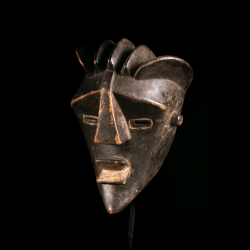
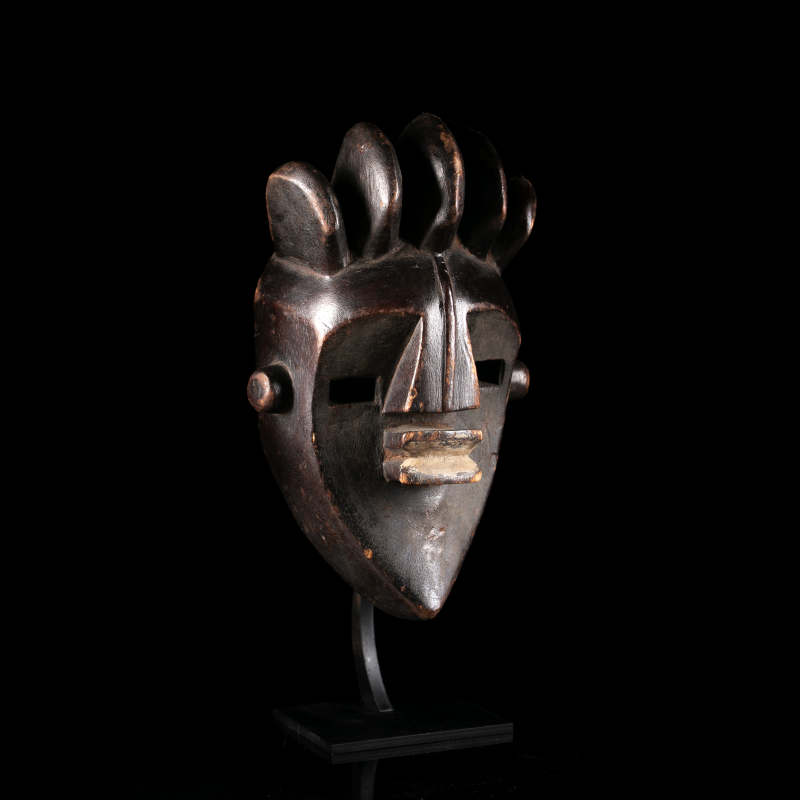
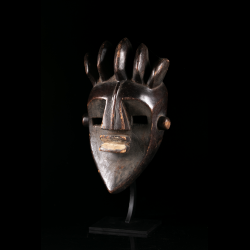
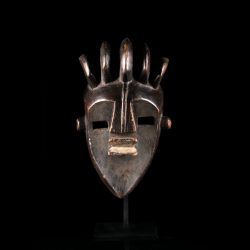
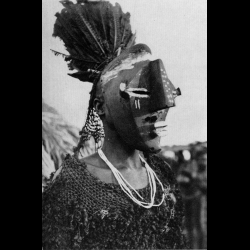
This Lwalwa, or Lwalu, mask is distinguished by the powerful geometric construction characteristic of the arts of the Kasai region. The face tapers towards a pointed chin and is structured around a long, strongly projecting triangular nose that forms the central axis of the composition. Two rectangular openings define the eyes beneath broad orbital planes, while a small projecting mouth retaining traces of pale pigment contrasts with the deep dark-brown to black patina. Cylindrical ears and, above all, an impressive headdress formed by five upright elements complete this almost architectural construction.
The sculpture achieves remarkable visual strength through an economical opposition between flat surfaces and projecting volumes. This conception relates directly to the male mask types known as mvondo or mfondo, also frequently written mvondo. Typologies based on field research distinguish these masks particularly through the development of the nose, often interpreted as a highly stylised avian form.
Lwalwa masks rank among the most radically abstract sculptural traditions of Central Africa. Early studies distinguished several principal types, including nkaki, shifola, nvondo/mfondo and mushika. Differentiating the nkaki from the mfondo can nevertheless be difficult: museum scholarship and research based on the fieldwork of Maesen and Timmermans emphasise the profile of the nose and its relationship with the headdress as the principal formal criteria.
The designation Mvondo, commonly used for this group of masks, is therefore convincing for the present work: a strongly projecting nose, highly structured facial planes, rectangular eye openings and a protruding mouth. For an academically cautious catalogue entry, however, I would retain the wording “Mvondo / Mfondo” in order to acknowledge the different spellings and typological nuances found in the literature.
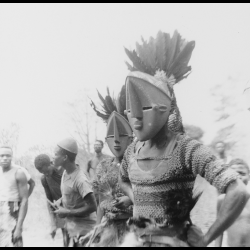
These masks were not conceived as autonomous sculptures. Worn with a costume during danced performances, they appeared notably in connection with the initiation and circumcision of young men within the Ngongo association. The Metropolitan Museum also records their role in performances intended to appease spiritual forces associated with hunting. Their sculptural power must therefore originally have been experienced through movement, music and choreography.
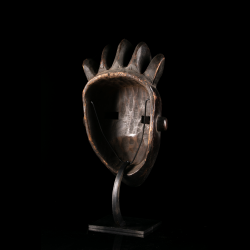
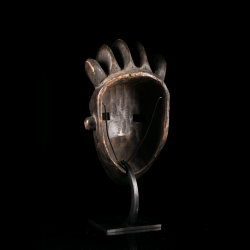
The present example offers an especially vigorous interpretation of this sculptural vocabulary. The sequence of five projecting elements above the forehead reinforces its vertical rhythm, while the nose, mouth and orbital planes construct the face through sharply articulated volumes. The deep patina, locally lightened through wear on the reliefs, gives the object a strong sense of age and use while preserving the clarity of the carving.
Data sheet
You might also like
This Lwalwa, or Lwalu, mask is distinguished by the powerful geometric construction characteristic of the arts of the Kasai region. The face tapers towards a pointed chin and is structured around a long, strongly projecting triangular nose that forms the central axis of the composition. Two rectangular openings define the eyes beneath broad orbital planes, while a small projecting mouth retaining traces of pale pigment contrasts with the deep dark-brown to black patina. Cylindrical ears and, above all, an impressive headdress formed by five upright elements complete this almost architectural construction.
The sculpture achieves remarkable visual strength through an economical opposition between flat surfaces and projecting volumes. This conception relates directly to the male mask types known as mvondo or mfondo, also frequently written mvondo. Typologies based on field research distinguish these masks particularly through the development of the nose, often interpreted as a highly stylised avian form.
Lwalwa masks rank among the most radically abstract sculptural traditions of Central Africa. Early studies distinguished several principal types, including nkaki, shifola, nvondo/mfondo and mushika. Differentiating the nkaki from the mfondo can nevertheless be difficult: museum scholarship and research based on the fieldwork of Maesen and Timmermans emphasise the profile of the nose and its relationship with the headdress as the principal formal criteria.
The designation Mvondo, commonly used for this group of masks, is therefore convincing for the present work: a strongly projecting nose, highly structured facial planes, rectangular eye openings and a protruding mouth. For an academically cautious catalogue entry, however, I would retain the wording “Mvondo / Mfondo” in order to acknowledge the different spellings and typological nuances found in the literature.
These masks were not conceived as autonomous sculptures. Worn with a costume during danced performances, they appeared notably in connection with the initiation and circumcision of young men within the Ngongo association. The Metropolitan Museum also records their role in performances intended to appease spiritual forces associated with hunting. Their sculptural power must therefore originally have been experienced through movement, music and choreography.
The present example offers an especially vigorous interpretation of this sculptural vocabulary. The sequence of five projecting elements above the forehead reinforces its vertical rhythm, while the nose, mouth and orbital planes construct the face through sharply articulated volumes. The deep patina, locally lightened through wear on the reliefs, gives the object a strong sense of age and use while preserving the clarity of the carving.