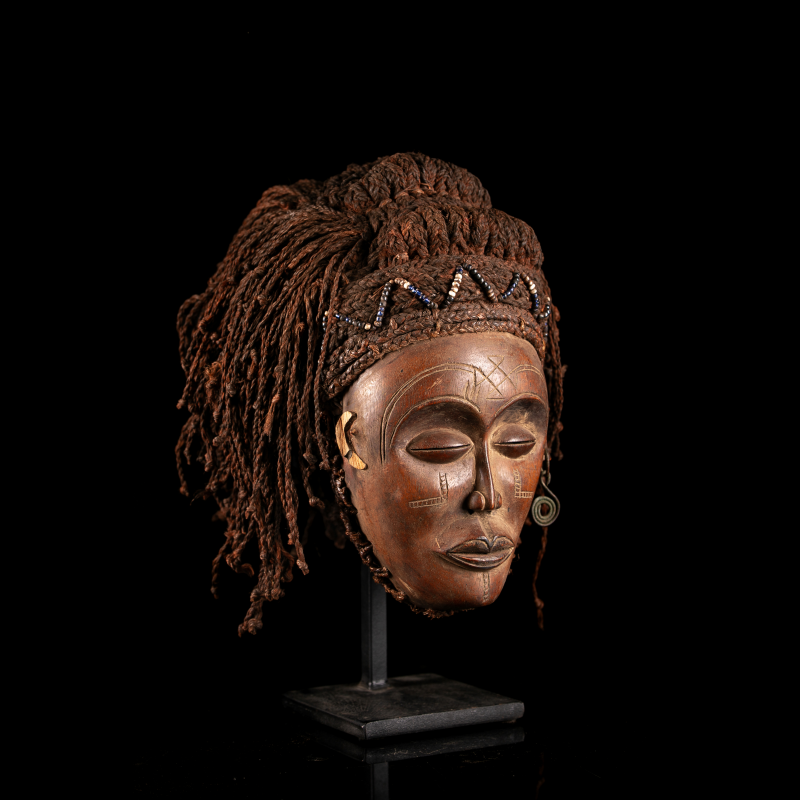
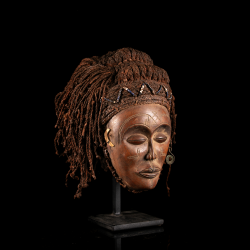
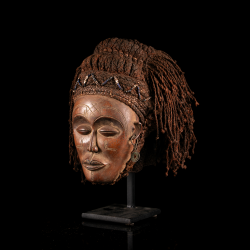
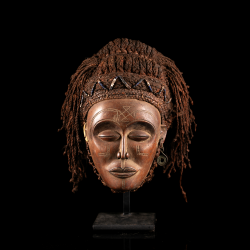
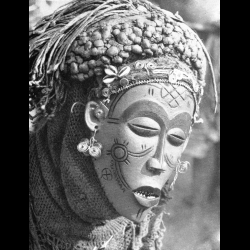
Of remarkable elegance, this female Chokwe mask of the Mwana Pwo type – historically known as Pwo embodies the ideal of feminine beauty celebrated in Chokwe artistic tradition. The delicately modelled oval face is structured by sweeping arched brows, elongated almost closed eyes and finely shaped lips. Geometric motifs incised on the forehead, cheeks and chin belong to the rich repertoire of scarification and body ornament associated with Chokwe identity and aesthetics.
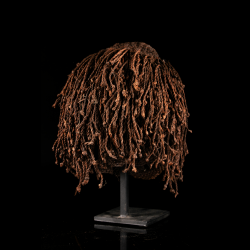
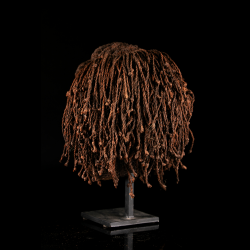
The spectacular and exceptionally well-preserved plant-fibre coiffure is one of the work’s most compelling features. Elaborately braided and embellished with small beads, it extends the sculpture into an impressive textile volume, while metal ear ornaments further enhance its refined character. Comparable masks in the Smithsonian collections retain elaborate fibre coiffures inspired by historical Chokwe women’s hairstyles.
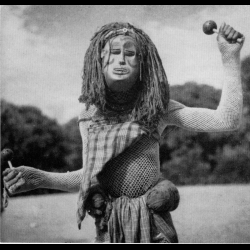
The Pwo mask celebrates womanhood and, more specifically, the female founding ancestor of the lineage within the matrilineal structure of Chokwe society. It was performed by a male dancer whose identity was completely concealed beneath a fibre costume, embodying ideals of grace, fertility and social accomplishment. Pwo masks appeared particularly in celebrations surrounding initiation and could perform alongside the male Cihongo mask, the pairing evoking prosperity and the continuity of the community.
The delicacy of the carving, harmonious facial modelling and above all the survival of the imposing coiffure give this example a particularly attractive presence for a collection devoted to the arts of Central Africa.
The custom-made metal display stand shown in the photographs is included with the mask, providing an immediate gallery-quality presentation.
Data sheet
You might also like
Of remarkable elegance, this female Chokwe mask of the Mwana Pwo type – historically known as Pwo embodies the ideal of feminine beauty celebrated in Chokwe artistic tradition. The delicately modelled oval face is structured by sweeping arched brows, elongated almost closed eyes and finely shaped lips. Geometric motifs incised on the forehead, cheeks and chin belong to the rich repertoire of scarification and body ornament associated with Chokwe identity and aesthetics.
The spectacular and exceptionally well-preserved plant-fibre coiffure is one of the work’s most compelling features. Elaborately braided and embellished with small beads, it extends the sculpture into an impressive textile volume, while metal ear ornaments further enhance its refined character. Comparable masks in the Smithsonian collections retain elaborate fibre coiffures inspired by historical Chokwe women’s hairstyles.
The Pwo mask celebrates womanhood and, more specifically, the female founding ancestor of the lineage within the matrilineal structure of Chokwe society. It was performed by a male dancer whose identity was completely concealed beneath a fibre costume, embodying ideals of grace, fertility and social accomplishment. Pwo masks appeared particularly in celebrations surrounding initiation and could perform alongside the male Cihongo mask, the pairing evoking prosperity and the continuity of the community.
The delicacy of the carving, harmonious facial modelling and above all the survival of the imposing coiffure give this example a particularly attractive presence for a collection devoted to the arts of Central Africa.
The custom-made metal display stand shown in the photographs is included with the mask, providing an immediate gallery-quality presentation.