
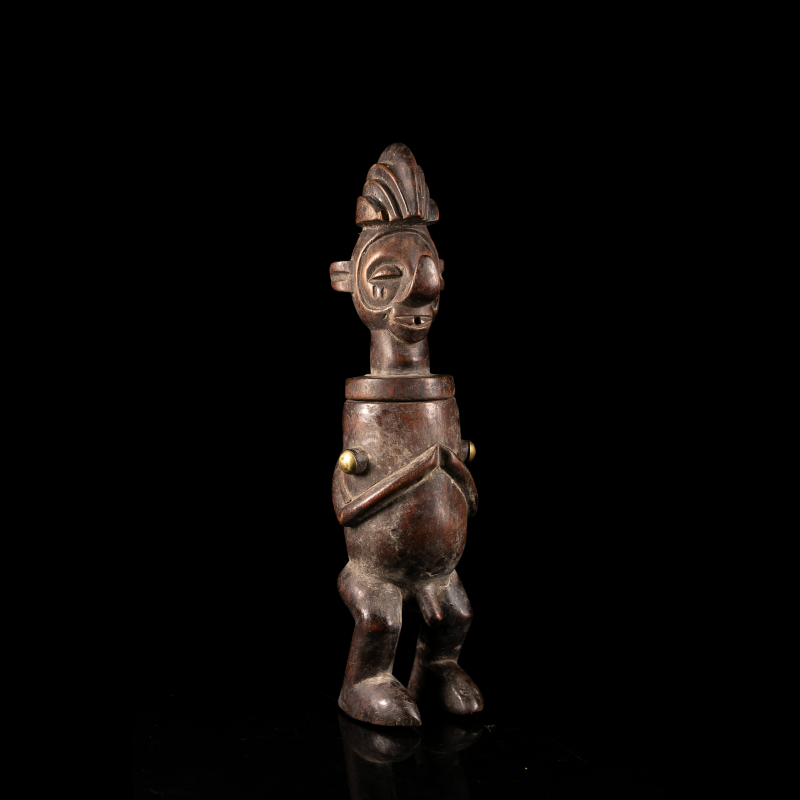
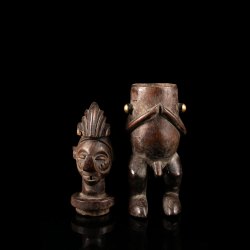
This Yaka male sculpture is more accurately identified as a kumbu di mpemba container figure rather than simply as a drinking cup. The decisive feature is the fully removable head, which closes the cavity carved into the body. Viviane Baeke specifically describes the kumbu di pheemba as an anthropomorphic receptacle intended to hold pheemba, the white clay or kaolin used during the investiture of Yaka chiefs. This substance played a role in the symbolic transmission of authority and vital force from a deceased chief to his successor.
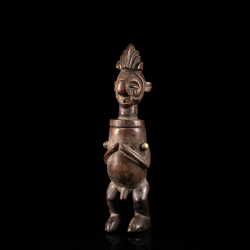
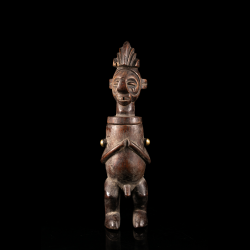
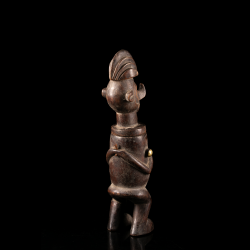
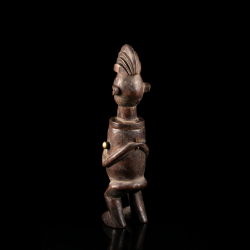
The figure displays the Yaka sculptural vocabulary with considerable character: a large projecting upturned nose, elongated nearly closed eyes, a mouth revealing the teeth, markings beneath the eyes and a prominent crested coiffure. Comparable features occur on documented Yaka works in the Metropolitan Museum and Smithsonian collections. The male body stands firmly on flexed legs, with a prominently modelled abdomen framed by long arms meeting across the front. Two copper-alloy studs accent the sides. Its deep brown patina, subtly modulated through handling and wear, contributes strongly to the sculptural presence of the piece.
The type is well documented: a nineteenth-century kumbu di pheemba published in Finality without End measures 24.5 cm (ours measures 27 cm), while another important example was published by Arthur P. Bourgeois in Art of the Yaka and Suku and presented as a Yaka ritual container from the Kwango region.
Data sheet
This Yaka male sculpture is more accurately identified as a kumbu di mpemba container figure rather than simply as a drinking cup. The decisive feature is the fully removable head, which closes the cavity carved into the body. Viviane Baeke specifically describes the kumbu di pheemba as an anthropomorphic receptacle intended to hold pheemba, the white clay or kaolin used during the investiture of Yaka chiefs. This substance played a role in the symbolic transmission of authority and vital force from a deceased chief to his successor.
The figure displays the Yaka sculptural vocabulary with considerable character: a large projecting upturned nose, elongated nearly closed eyes, a mouth revealing the teeth, markings beneath the eyes and a prominent crested coiffure. Comparable features occur on documented Yaka works in the Metropolitan Museum and Smithsonian collections. The male body stands firmly on flexed legs, with a prominently modelled abdomen framed by long arms meeting across the front. Two copper-alloy studs accent the sides. Its deep brown patina, subtly modulated through handling and wear, contributes strongly to the sculptural presence of the piece.
The type is well documented: a nineteenth-century kumbu di pheemba published in Finality without End measures 24.5 cm (ours measures 27 cm), while another important example was published by Arthur P. Bourgeois in Art of the Yaka and Suku and presented as a Yaka ritual container from the Kwango region.