- Reduced price
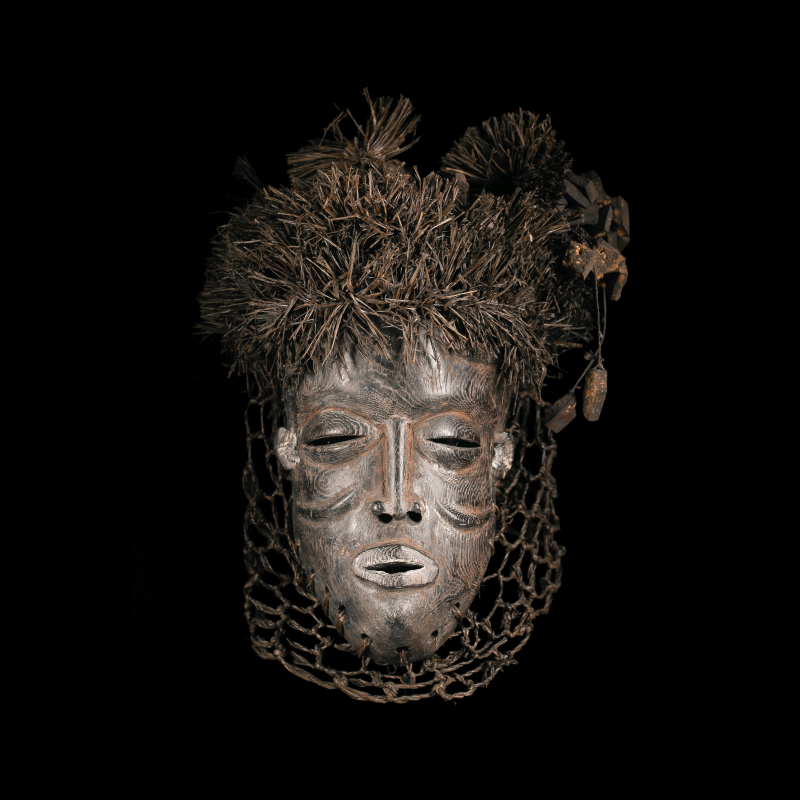
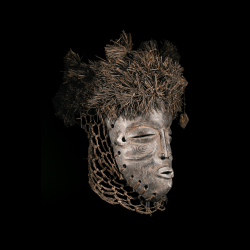
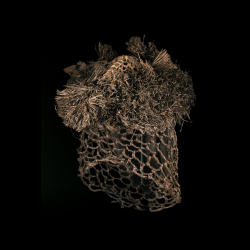
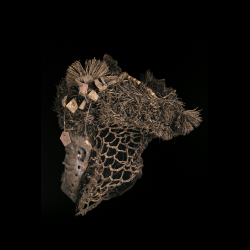
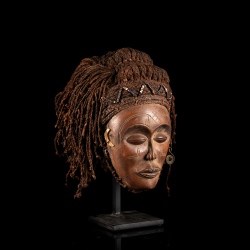
Wooden mask with a dark brown patina, retaining an important assemblage of braided and knotted plant fibres. The face, with narrow slit eyes, is enlivened by curvilinear scarification marks across the cheeks. The substantial fibre coiffure and surrounding netting are particularly compelling surviving elements of the ensemble.
Among the Chokwe and related Luvale/Lwena, Luchazi, Lunda and Mbunda peoples, masquerades belong to the broader world of the makishi, masked characters associated especially with the male mukanda initiation cycle. These figures are not simply portraits: they embody social personalities, values and spiritual presences, contributing to the education of young initiates. Some are protective, while others are satirical, didactic or connected with ideals of behaviour and community identity.
The close cultural relationship between Chokwe and Luvale communities accounts for the many stylistic exchanges visible in their masking traditions. The surviving coiffure and fibre netting are especially significant, reminding us that the carved face originally formed only one part of a much larger costume intended to transform and conceal the dancer. Comparable Chokwe masks in the Smithsonian collections likewise combine carved wood, pigment and elaborate fibre structures.
You might also like
Wooden mask with a dark brown patina, retaining an important assemblage of braided and knotted plant fibres. The face, with narrow slit eyes, is enlivened by curvilinear scarification marks across the cheeks. The substantial fibre coiffure and surrounding netting are particularly compelling surviving elements of the ensemble.
Among the Chokwe and related Luvale/Lwena, Luchazi, Lunda and Mbunda peoples, masquerades belong to the broader world of the makishi, masked characters associated especially with the male mukanda initiation cycle. These figures are not simply portraits: they embody social personalities, values and spiritual presences, contributing to the education of young initiates. Some are protective, while others are satirical, didactic or connected with ideals of behaviour and community identity.
The close cultural relationship between Chokwe and Luvale communities accounts for the many stylistic exchanges visible in their masking traditions. The surviving coiffure and fibre netting are especially significant, reminding us that the carved face originally formed only one part of a much larger costume intended to transform and conceal the dancer. Comparable Chokwe masks in the Smithsonian collections likewise combine carved wood, pigment and elaborate fibre structures.