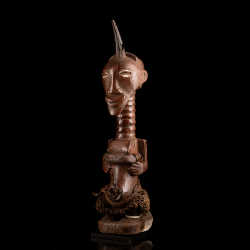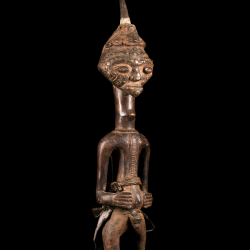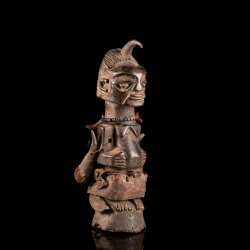
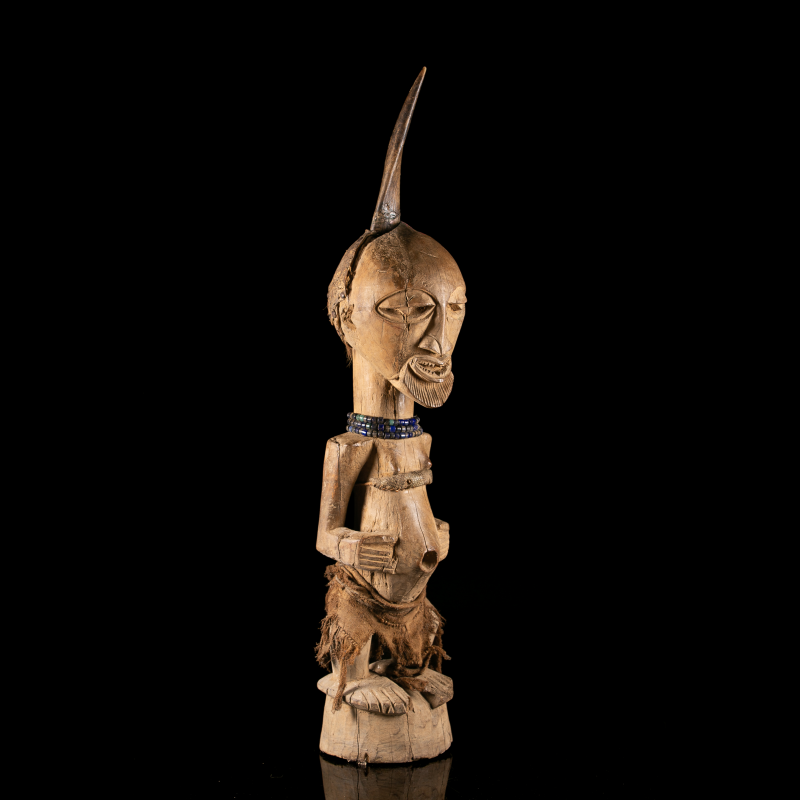
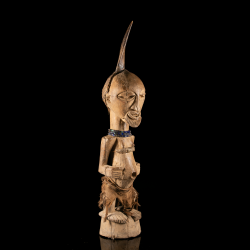
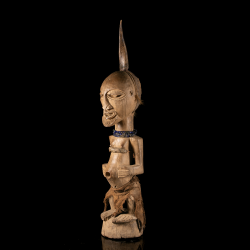
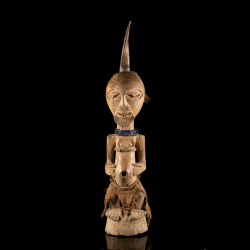
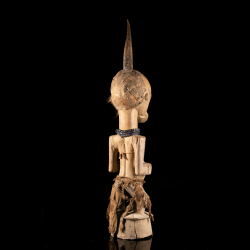
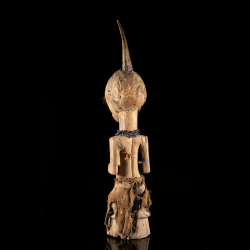
Important Nkishi power figure from the Songye of the Democratic Republic of the Congo, standing 81 cm high. Its monumental scale strongly suggests a communal mankishi figure rather than a smaller object intended for individual protection.
Among the Songye, a nkishi acted as an intermediary between the human world, ancestral spirits and supernatural forces. Its creation brought together the work of a sculptor and that of a ritual specialist, the nganga, who activated the figure by inserting bishimba: powerful compounds of animal, vegetal and mineral substances. These were commonly placed inside cavities in the head, abdomen or navel. Once empowered, large communal mankishi served the welfare of an entire community, protecting against illness and sorcery while promoting fertility, prosperity and social cohesion.
This example retains several characteristic elements associated with such ritual activation. The spectacular horn projecting from the crown may originally have served as a receptacle for powerful substances or as a means of reinforcing the figure's spiritual potency. The strands of beads around the neck, together with surviving fibers, cloth and bindings, likewise belong to the cumulative material language of Songye power figures. A circular opening visible on the abdomen corresponds to one of the areas commonly used to house ritual substances. Comparable Songye figures combine horns, beads, skins, fibers and organic matter to enhance their efficacy.
Large communal figures were kept in designated places within the village and placed under the care of a guardian. They could be brought out for collective consultations, ceremonies and celebrations associated with the new moon, a symbol of renewal, fertility and prosperity. Some were considered sufficiently powerful that they were transported without being touched directly.
The present sculpture is distinguished by its pronounced verticality, angular arms and strongly enlarged head. Large almond-shaped eyes, exposed teeth, a finely striated beard and the towering horn give the figure an especially commanding presence. Age cracks, surface wear and the surviving ritual attachments further contribute to the powerful character of this substantial example.
Data sheet
You might also like
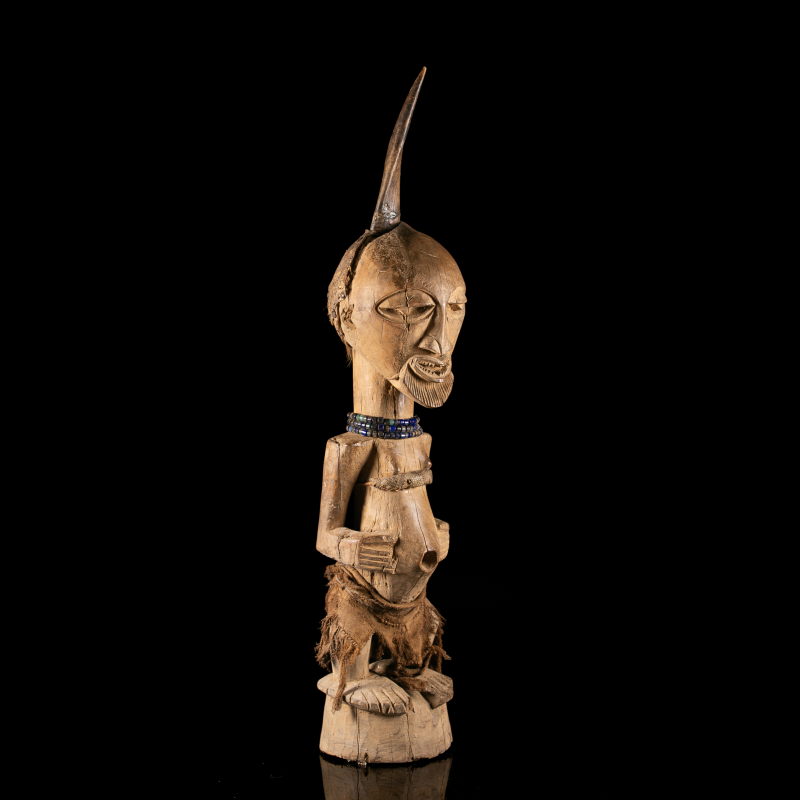
Important Nkishi power figure from the Songye of the Democratic Republic of the Congo, standing 81 cm high. Its monumental scale strongly suggests a communal mankishi figure rather than a smaller object intended for individual protection.
Among the Songye, a nkishi acted as an intermediary between the human world, ancestral spirits and supernatural forces. Its creation brought together the work of a sculptor and that of a ritual specialist, the nganga, who activated the figure by inserting bishimba: powerful compounds of animal, vegetal and mineral substances. These were commonly placed inside cavities in the head, abdomen or navel. Once empowered, large communal mankishi served the welfare of an entire community, protecting against illness and sorcery while promoting fertility, prosperity and social cohesion.
This example retains several characteristic elements associated with such ritual activation. The spectacular horn projecting from the crown may originally have served as a receptacle for powerful substances or as a means of reinforcing the figure's spiritual potency. The strands of beads around the neck, together with surviving fibers, cloth and bindings, likewise belong to the cumulative material language of Songye power figures. A circular opening visible on the abdomen corresponds to one of the areas commonly used to house ritual substances. Comparable Songye figures combine horns, beads, skins, fibers and organic matter to enhance their efficacy.
Large communal figures were kept in designated places within the village and placed under the care of a guardian. They could be brought out for collective consultations, ceremonies and celebrations associated with the new moon, a symbol of renewal, fertility and prosperity. Some were considered sufficiently powerful that they were transported without being touched directly.
The present sculpture is distinguished by its pronounced verticality, angular arms and strongly enlarged head. Large almond-shaped eyes, exposed teeth, a finely striated beard and the towering horn give the figure an especially commanding presence. Age cracks, surface wear and the surviving ritual attachments further contribute to the powerful character of this substantial example.