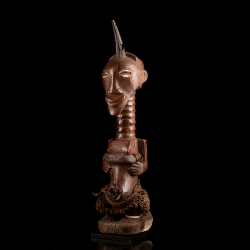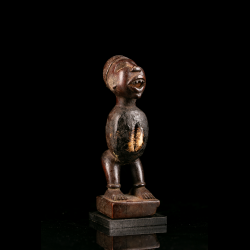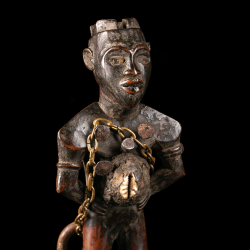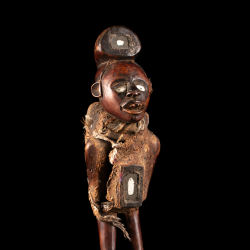
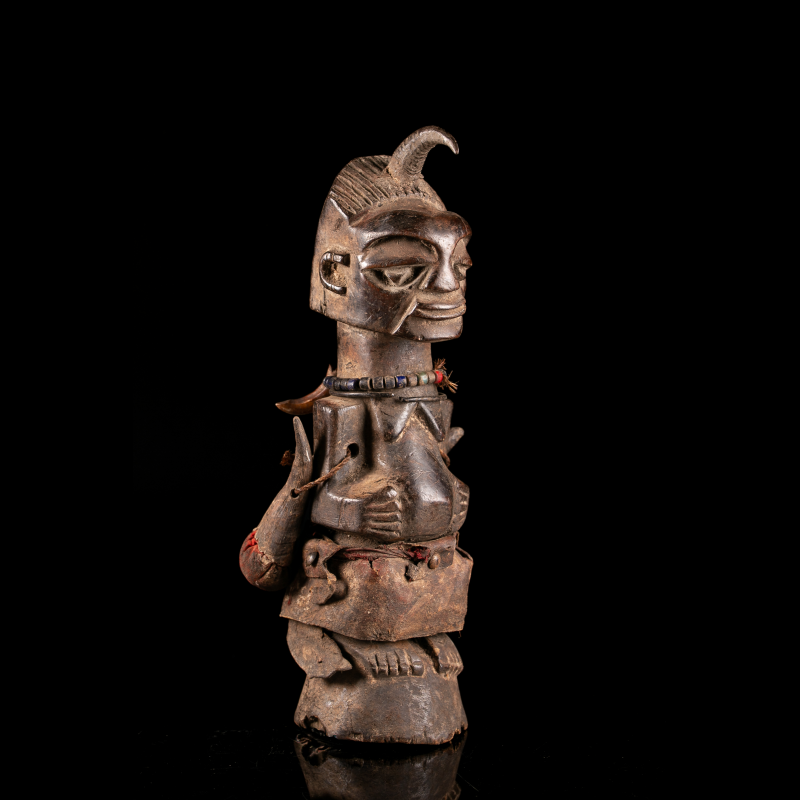
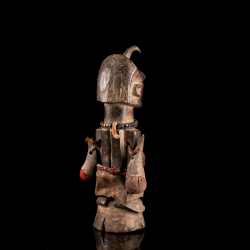
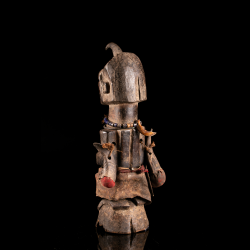
Powerful female Songye figure of the nkishi type, combining a hieratic sculptural structure with a remarkable assemblage of applied elements. The face is firmly modelled beneath a broad brow, with half-closed eyes, a triangular nose and geometric markings accentuating the cheeks. A horn-like projection rises from the striated coiffure. A beaded necklace, fibre ties, belt, textile or hide covering and two suspended lateral elements further enhance the figure’s material presence.
Among the Songye, a nkishi — plural mankishi — was more than a carved figure: it became a power object through the intervention of a ritual specialist, or nganga. The specialist introduced or attached potent substances known as bishimba within cavities and receptacles, particularly in the head and abdomen. Such figures could serve in protection, healing and mediation between the human and spiritual realms.
The survival of numerous attachments on this example is especially noteworthy: beads, fibres and peripheral ritual elements were not merely decorative, but formed part of the ritual constitution of Songye power figures. Their precise contents or individual functions, however, cannot be established without material analysis. The combination of sculptural authority, ritual complexity and a richly handled surface gives this figure an exceptionally compelling presence.
Data sheet
You might also like
Powerful female Songye figure of the nkishi type, combining a hieratic sculptural structure with a remarkable assemblage of applied elements. The face is firmly modelled beneath a broad brow, with half-closed eyes, a triangular nose and geometric markings accentuating the cheeks. A horn-like projection rises from the striated coiffure. A beaded necklace, fibre ties, belt, textile or hide covering and two suspended lateral elements further enhance the figure’s material presence.
Among the Songye, a nkishi — plural mankishi — was more than a carved figure: it became a power object through the intervention of a ritual specialist, or nganga. The specialist introduced or attached potent substances known as bishimba within cavities and receptacles, particularly in the head and abdomen. Such figures could serve in protection, healing and mediation between the human and spiritual realms.
The survival of numerous attachments on this example is especially noteworthy: beads, fibres and peripheral ritual elements were not merely decorative, but formed part of the ritual constitution of Songye power figures. Their precise contents or individual functions, however, cannot be established without material analysis. The combination of sculptural authority, ritual complexity and a richly handled surface gives this figure an exceptionally compelling presence.