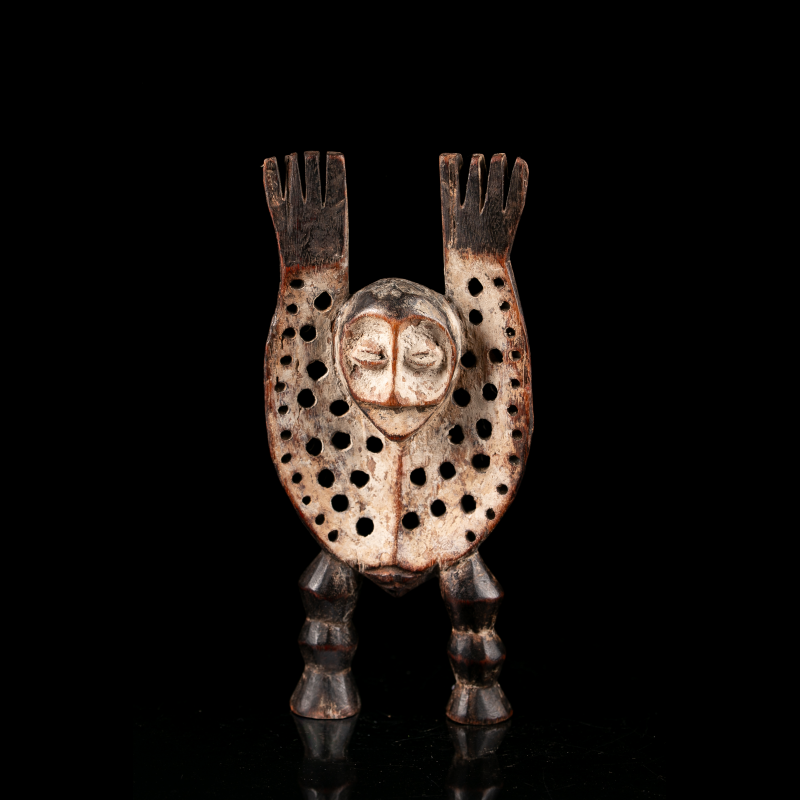
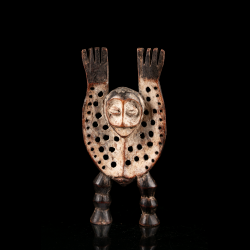
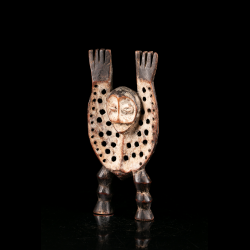
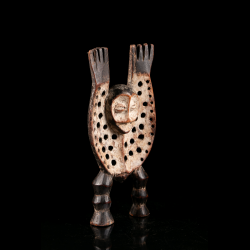
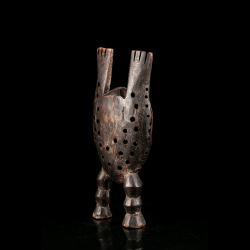
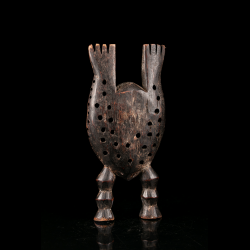
This remarkable Lega figure with raised arms can be identified with considerable confidence as a Katanda, a type of initiation object associated with the Bwami society. A particularly close comparison is preserved at the New Orleans Museum of Art, where a Katanda is catalogued as an anthropomorphic “sleeping mat” with raised arms, a kaolin-covered face and a torso pierced with numerous holes. The present sculpture displays the same striking conception: a flattened oval body extensively perforated across its surface, a pale projecting face at the centre, vertically extended arms ending in schematic hands, and strongly articulated legs.
The holes are not merely decorative. Within Bwami teaching, Katanda, literally a sleeping mat, evokes the image of a mat damaged by red ants. The Bowers Museum explains that this metaphor was used to address laziness, moral laxity and sexual behaviour capable of spreading disorder through the community.
Such a sculpture should therefore be understood less as an individual portrait than as a mnemonic image used to transmit moral instruction. The contrast between the whitened face, dark wooden body and dense constellation of perforations gives this example an especially compelling sculptural presence.
Formerly in the collection of Aimé-Lucien Mbungu Mbuka – Galerie Antika, Kinshasa, Democratic Republic of the Congo.
Aimé-Lucien Mbungu Mbuka has been active for several decades in the preservation and promotion of traditional Congolese arts in Kinshasa, where he directs Galerie Antika at the Boboto Cultural Center. His leadership of the gallery is also independently documented in *Mémoires du Congo* publications.
Data sheet
You might also like
This remarkable Lega figure with raised arms can be identified with considerable confidence as a Katanda, a type of initiation object associated with the Bwami society. A particularly close comparison is preserved at the New Orleans Museum of Art, where a Katanda is catalogued as an anthropomorphic “sleeping mat” with raised arms, a kaolin-covered face and a torso pierced with numerous holes. The present sculpture displays the same striking conception: a flattened oval body extensively perforated across its surface, a pale projecting face at the centre, vertically extended arms ending in schematic hands, and strongly articulated legs.
The holes are not merely decorative. Within Bwami teaching, Katanda, literally a sleeping mat, evokes the image of a mat damaged by red ants. The Bowers Museum explains that this metaphor was used to address laziness, moral laxity and sexual behaviour capable of spreading disorder through the community.
Such a sculpture should therefore be understood less as an individual portrait than as a mnemonic image used to transmit moral instruction. The contrast between the whitened face, dark wooden body and dense constellation of perforations gives this example an especially compelling sculptural presence.
Formerly in the collection of Aimé-Lucien Mbungu Mbuka – Galerie Antika, Kinshasa, Democratic Republic of the Congo.
Aimé-Lucien Mbungu Mbuka has been active for several decades in the preservation and promotion of traditional Congolese arts in Kinshasa, where he directs Galerie Antika at the Boboto Cultural Center. His leadership of the gallery is also independently documented in *Mémoires du Congo* publications.