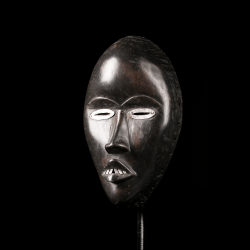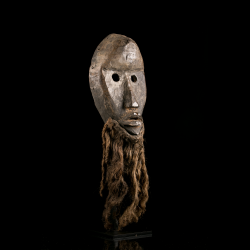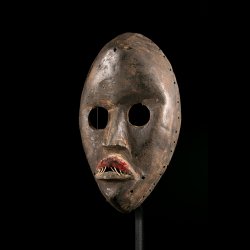
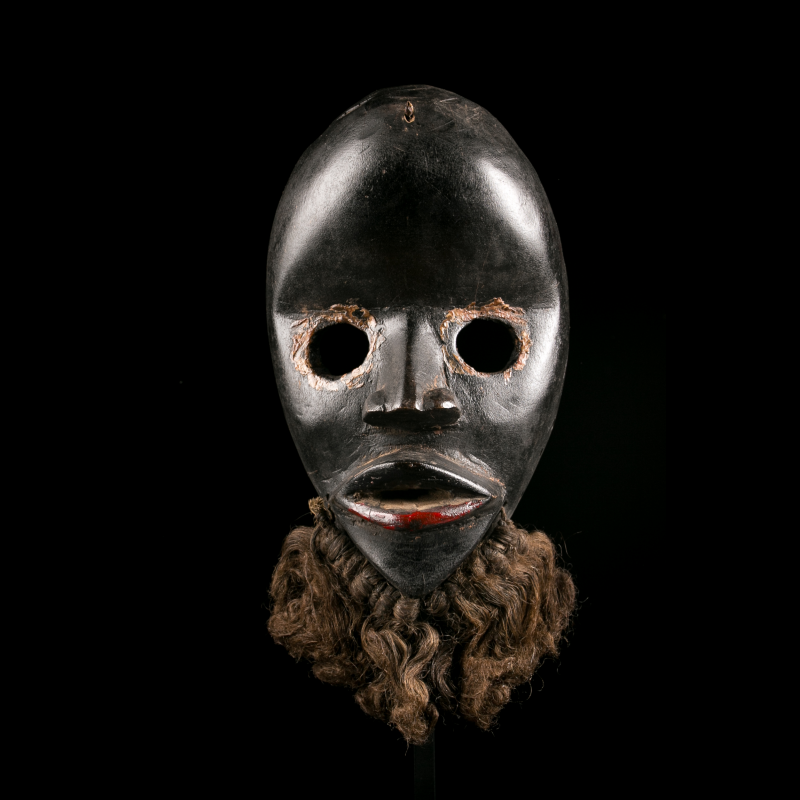
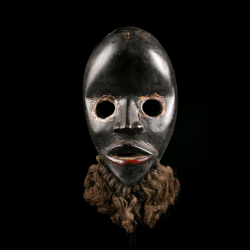
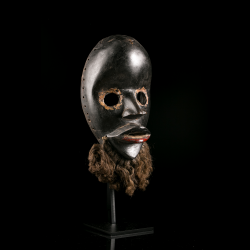
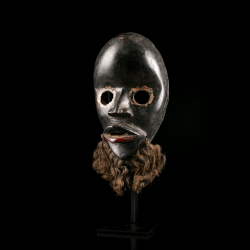


Dan masks, also known as Yacouba masks, originate from the Dan people, who live in western Ivory Coast and Liberia.
They are not simply decorative objects: they are sacred works of art, often representing spiritual forces of the forest, ancestors, or immaterial spirits, and serving as bridges between the world of humans and the world of spirits during dances and rituals.
There are several types of Dan masks, each with a specific form and social or ritual function.
The Deangle mask, with its oval face and slit-like eyes, symbolizes feminine beauty and is used in certain initiation rites.
The Tankagle and Bagle masks, larger or more grotesque, entertain the community during festivals through dances and mimes.
The Gunyege mask, worn during ritual races, is sometimes chased by other participants, formerly to train the men.
The Zakpai mask, recognizable by a red cloth over its eyes, is used to extinguish bushfires during the dry season.
Bugle, Kaogle, Gagon: other masks used to excite warriors, create joy, or mark important ceremonies.
Go ge: reserved for major occasions, particularly to announce the death of a chief.
In addition to these life-size human figures, the Dan also use small passport-masks, worn on the body or kept in bags during rituals, as witnesses or protective objects in initiation ceremonies.
The masks are carved from wood and often adorned with plant fibers, cowrie shells, fabric, or raffia, and polished to obtain a dark patina through contact with the dancers and the passage of time.
Data sheet
You might also like
Dan masks, also known as Yacouba masks, originate from the Dan people, who live in western Ivory Coast and Liberia.
They are not simply decorative objects: they are sacred works of art, often representing spiritual forces of the forest, ancestors, or immaterial spirits, and serving as bridges between the world of humans and the world of spirits during dances and rituals.
There are several types of Dan masks, each with a specific form and social or ritual function.
The Deangle mask, with its oval face and slit-like eyes, symbolizes feminine beauty and is used in certain initiation rites.
The Tankagle and Bagle masks, larger or more grotesque, entertain the community during festivals through dances and mimes.
The Gunyege mask, worn during ritual races, is sometimes chased by other participants, formerly to train the men.
The Zakpai mask, recognizable by a red cloth over its eyes, is used to extinguish bushfires during the dry season.
Bugle, Kaogle, Gagon: other masks used to excite warriors, create joy, or mark important ceremonies.
Go ge: reserved for major occasions, particularly to announce the death of a chief.
In addition to these life-size human figures, the Dan also use small passport-masks, worn on the body or kept in bags during rituals, as witnesses or protective objects in initiation ceremonies.
The masks are carved from wood and often adorned with plant fibers, cowrie shells, fabric, or raffia, and polished to obtain a dark patina through contact with the dancers and the passage of time.