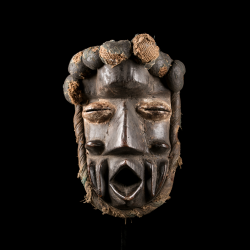
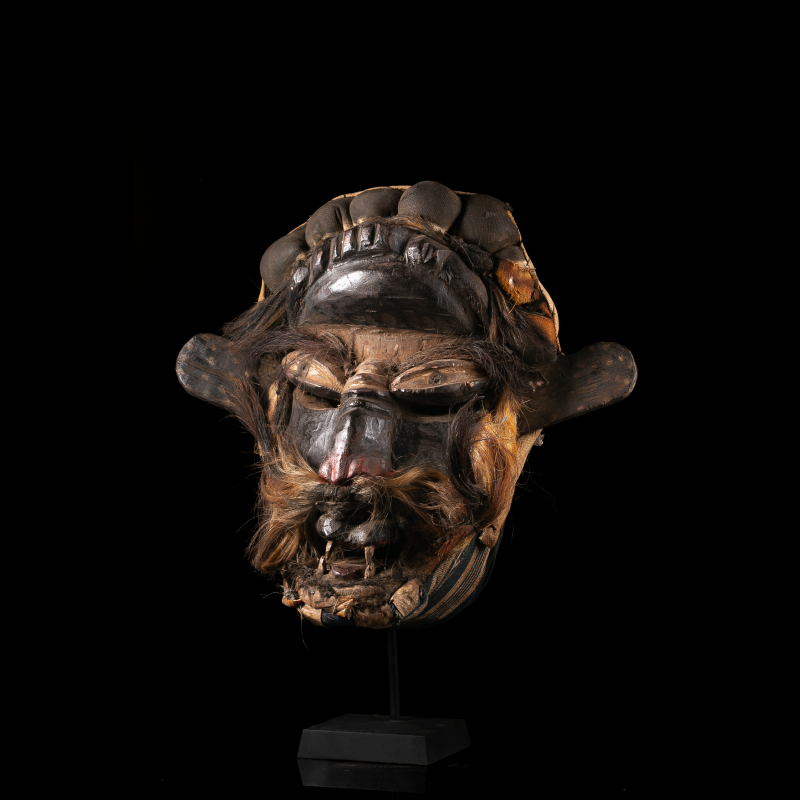
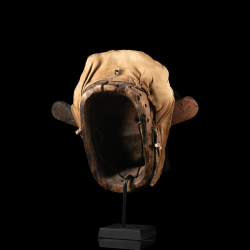
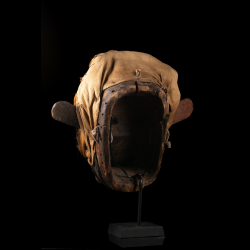
With its commanding visual presence, this mask attributed to the Wè, also known as the Guéré, is distinguished by a powerful construction combining carved wood with a variety of attached materials. The deliberately expressive face is organised through broad sculptural volumes: a domed forehead, heavy brows, deeply shadowed eyes, a prominent nose and an open mouth displaying two fang-like elements. Large projecting ears further emphasise its dramatic silhouette.
The carving is enriched with abundant hair forming a moustache, beard and framing around the eyes. A padded cloth headdress rises above the forehead, while additional textile elements cover the back of the mask. This combination of wood, fiber, hair, cloth and organic components is associated with certain Wè masks conceived as complex assemblages, whose visual effect depended as much on their materials as on the underlying carving. Comparable museum examples combine wood with cloth, human hair, animal hide and teeth.
Within Wè communities, masks could appear in a range of settings connected with mediation, social regulation, justice or important communal events. However, assigning a specific name or function to a mask separated from its costume, performance and original documentation remains difficult.
Through its vigorous modelling, layered materials and fierce expression, this example possesses exceptional decorative impact. The display stand shown in the photographs is included.
Data sheet
You might also like
With its commanding visual presence, this mask attributed to the Wè, also known as the Guéré, is distinguished by a powerful construction combining carved wood with a variety of attached materials. The deliberately expressive face is organised through broad sculptural volumes: a domed forehead, heavy brows, deeply shadowed eyes, a prominent nose and an open mouth displaying two fang-like elements. Large projecting ears further emphasise its dramatic silhouette.
The carving is enriched with abundant hair forming a moustache, beard and framing around the eyes. A padded cloth headdress rises above the forehead, while additional textile elements cover the back of the mask. This combination of wood, fiber, hair, cloth and organic components is associated with certain Wè masks conceived as complex assemblages, whose visual effect depended as much on their materials as on the underlying carving. Comparable museum examples combine wood with cloth, human hair, animal hide and teeth.
Within Wè communities, masks could appear in a range of settings connected with mediation, social regulation, justice or important communal events. However, assigning a specific name or function to a mask separated from its costume, performance and original documentation remains difficult.
Through its vigorous modelling, layered materials and fierce expression, this example possesses exceptional decorative impact. The display stand shown in the photographs is included.