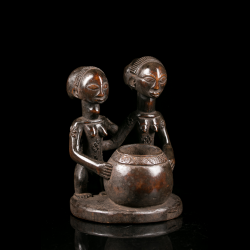
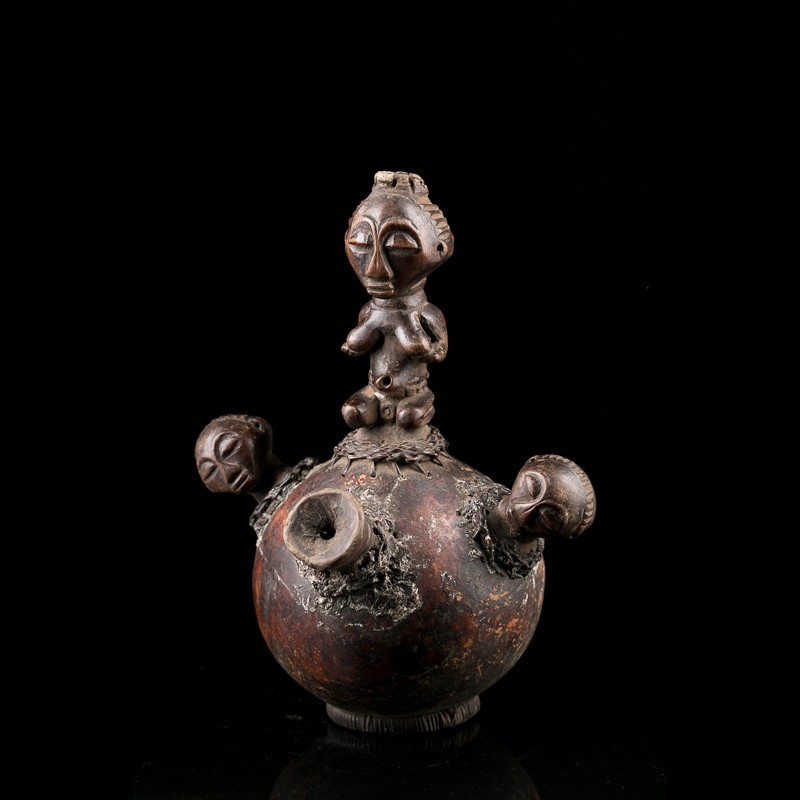
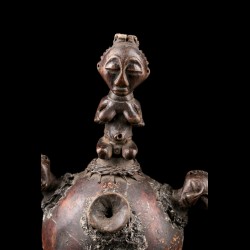
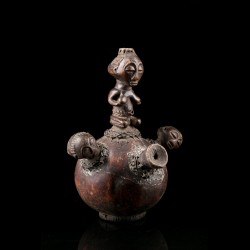
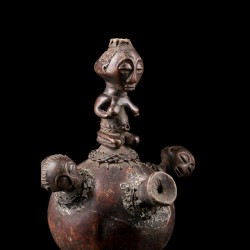

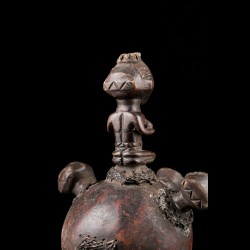
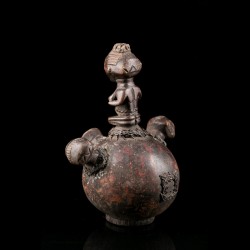
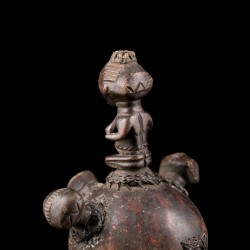
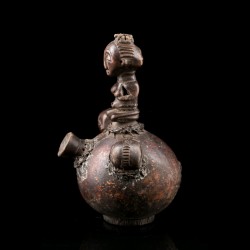
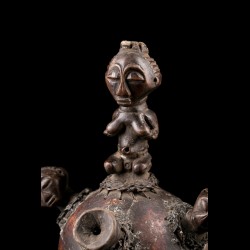
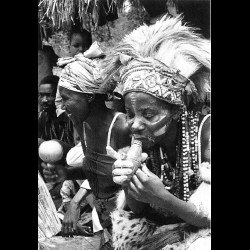
This Luba calabash is composed of a perforated sphere on which we can see two lateral heads and a kneeling female statuette, hands on her chest. This type of object could be used by diviners and Mbudye priestess as part of the divinatory practices of Bugabo society.
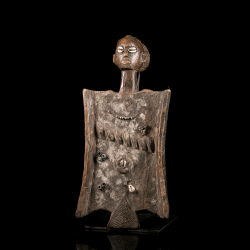
Like the Luba, the Hemba and Tabwa used this type of object in divinatory rites. The half wooden statuette is perforated at the top of the skull, which is aligned with an opening in the gourd. Small objects such as nuts or pebbles were slipped through the figure into the gourd, which was then manipulated as part of the divination process.
The Luba called the western people the "Hemba". This alluded to their way of pronouncing the language and the way they dress. Although the various ethnic groups living north of Lukuga call themselves "Hemba", the complex social differences covered by the term must be acknowledged.
The southern groups, living in families, clans and chiefdoms, all traced their origins to one place, the Hundi Mountains between Luama and Lulindi.
These included the Niembo, Honga, Mambwe, Nkuvu, Muhona and many other groups. North of the Luika, the Hemba groups mingle with others in a more complex way: Zula, Bangubangu, Boyo and Bembi. Ancestor veneration is an important feature of life in large Hemba families. The beautiful statuary amply testifies to this, but other ritual objects bear witness to an art in many forms: the kabeja, a two-headed statuette linked to twins, and the lagalla, a large post in the shape of a head placed at the edge of the village.
See Africa the Art of a Continent, edited by Tom Phillips, p 293
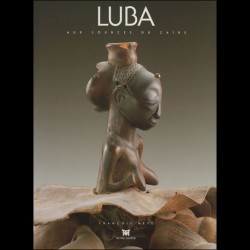
Cf. Luba, at the sources of the Zaire river, F. NEYT, 1993
Data sheet
You might also like
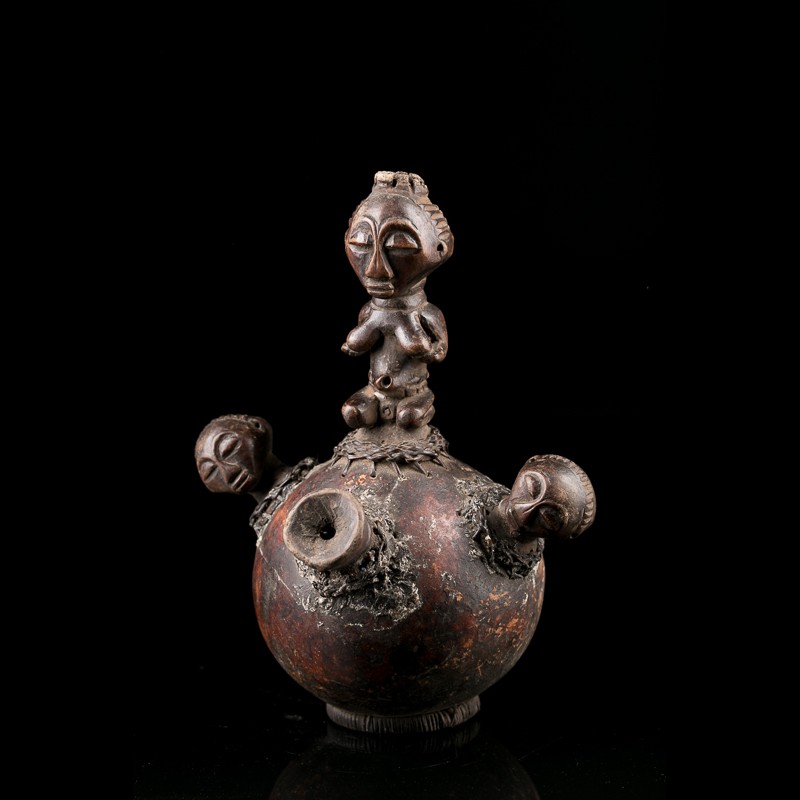
This Luba calabash is composed of a perforated sphere on which we can see two lateral heads and a kneeling female statuette, hands on her chest. This type of object could be used by diviners and Mbudye priestess as part of the divinatory practices of Bugabo society.
Like the Luba, the Hemba and Tabwa used this type of object in divinatory rites. The half wooden statuette is perforated at the top of the skull, which is aligned with an opening in the gourd. Small objects such as nuts or pebbles were slipped through the figure into the gourd, which was then manipulated as part of the divination process.
The Luba called the western people the "Hemba". This alluded to their way of pronouncing the language and the way they dress. Although the various ethnic groups living north of Lukuga call themselves "Hemba", the complex social differences covered by the term must be acknowledged.
The southern groups, living in families, clans and chiefdoms, all traced their origins to one place, the Hundi Mountains between Luama and Lulindi.
These included the Niembo, Honga, Mambwe, Nkuvu, Muhona and many other groups. North of the Luika, the Hemba groups mingle with others in a more complex way: Zula, Bangubangu, Boyo and Bembi. Ancestor veneration is an important feature of life in large Hemba families. The beautiful statuary amply testifies to this, but other ritual objects bear witness to an art in many forms: the kabeja, a two-headed statuette linked to twins, and the lagalla, a large post in the shape of a head placed at the edge of the village.
See Africa the Art of a Continent, edited by Tom Phillips, p 293
Cf. Luba, at the sources of the Zaire river, F. NEYT, 1993