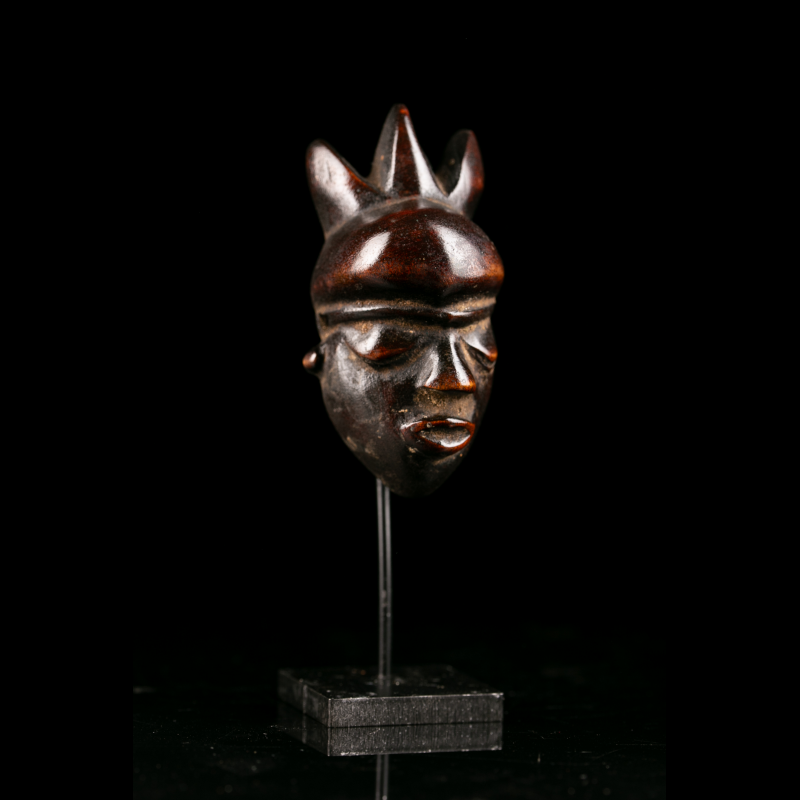
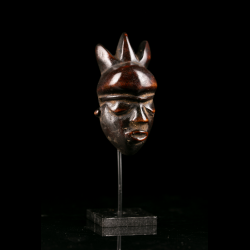
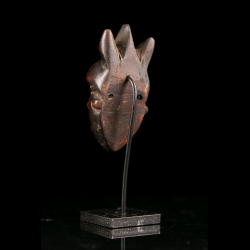
This remarkable Ikhoko from the Pende culture of the Democratic Republic of the Congo takes the form of a finely carved miniature mask, an early protective pendant or personal charm that beautifully reflects the refinement of Central African miniature arts. These small effigies, worn on the body, suspended, or kept as protective objects, held a distinctive place within the symbolic world of the Pende.
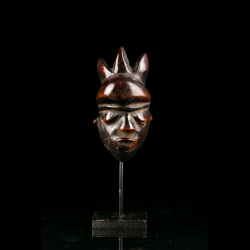
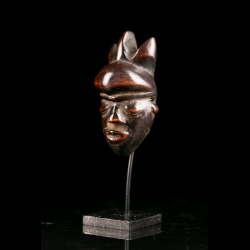
The piece is immediately appealing for the accuracy of its typology, the respect of traditional iconography, and the expressive quality of its carving. The face, structured by a powerful forehead, recessed eyes, slightly open mouth, and energetic treatment of the volumes, faithfully reproduces the great aesthetic codes of monumental Pende masks in a reduced format of rare intensity.
The tripartite crest, compact facial proportions, and tension of the lines give this piece a remarkable presence despite its modest size. Far from being anecdotal, this type of sculptural reduction required true technical mastery in order to condense, within only a few centimeters, the visual power of a full-scale ceremonial mask.
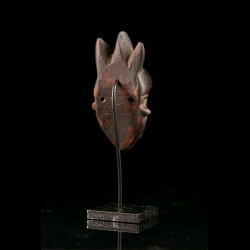
The age of this example is immediately evident through the quality of the wood, the depth of the surface, repeated handling marks, and the natural wear of the raised areas. The patina displays the dense and vibrant character sought after by connoisseurs, revealing an object preserved and transmitted over a long period of time.
Of particular interest, the piece retains in places slight traces of an old protective varnish applied during the 20th century, a practice frequently encountered in colonial circles during the 1950s and 1960s, when certain European collectors believed this would help preserve works brought back from Africa. Rather than diminishing the reading of the object, these discreet remnants now stand as an additional marker of age, historical journey, and passage through early field collections.
The family provenance further enhances the importance of the piece. It comes from a family established in the Congo during the colonial era, active both before and after independence, and later involved in the development of some of the first recognized interior decoration businesses in Kinshasa. This context gives the object a coherent history and a documentary background especially attractive to collectors attentive to provenance.
Through its rarity, authentic signs of use, quality of carving, and compelling history of preservation, this early Pende Ikhoko stands as a choice work for any collection devoted to Congolese arts, miniature power objects, or the classical sculptural traditions of the Pende.
Data sheet
You might also like
This remarkable Ikhoko from the Pende culture of the Democratic Republic of the Congo takes the form of a finely carved miniature mask, an early protective pendant or personal charm that beautifully reflects the refinement of Central African miniature arts. These small effigies, worn on the body, suspended, or kept as protective objects, held a distinctive place within the symbolic world of the Pende.
The piece is immediately appealing for the accuracy of its typology, the respect of traditional iconography, and the expressive quality of its carving. The face, structured by a powerful forehead, recessed eyes, slightly open mouth, and energetic treatment of the volumes, faithfully reproduces the great aesthetic codes of monumental Pende masks in a reduced format of rare intensity.
The tripartite crest, compact facial proportions, and tension of the lines give this piece a remarkable presence despite its modest size. Far from being anecdotal, this type of sculptural reduction required true technical mastery in order to condense, within only a few centimeters, the visual power of a full-scale ceremonial mask.
The age of this example is immediately evident through the quality of the wood, the depth of the surface, repeated handling marks, and the natural wear of the raised areas. The patina displays the dense and vibrant character sought after by connoisseurs, revealing an object preserved and transmitted over a long period of time.
Of particular interest, the piece retains in places slight traces of an old protective varnish applied during the 20th century, a practice frequently encountered in colonial circles during the 1950s and 1960s, when certain European collectors believed this would help preserve works brought back from Africa. Rather than diminishing the reading of the object, these discreet remnants now stand as an additional marker of age, historical journey, and passage through early field collections.
The family provenance further enhances the importance of the piece. It comes from a family established in the Congo during the colonial era, active both before and after independence, and later involved in the development of some of the first recognized interior decoration businesses in Kinshasa. This context gives the object a coherent history and a documentary background especially attractive to collectors attentive to provenance.
Through its rarity, authentic signs of use, quality of carving, and compelling history of preservation, this early Pende Ikhoko stands as a choice work for any collection devoted to Congolese arts, miniature power objects, or the classical sculptural traditions of the Pende.