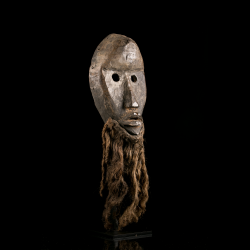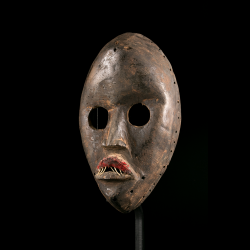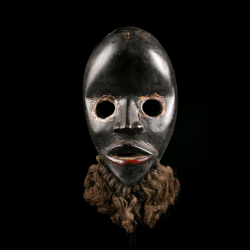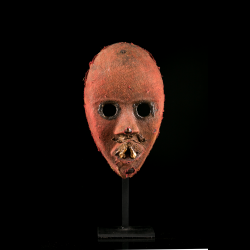
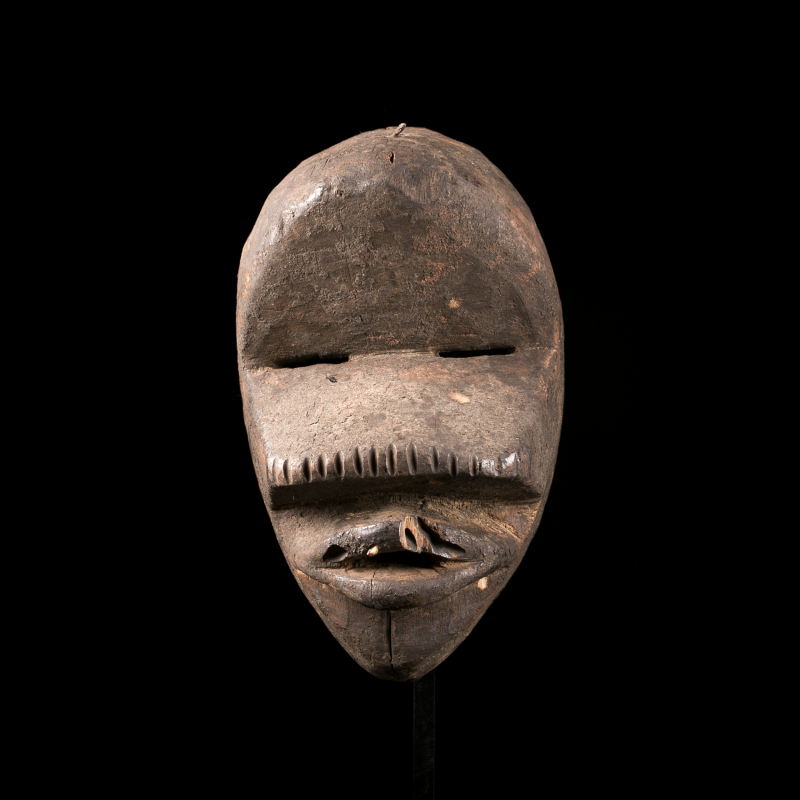
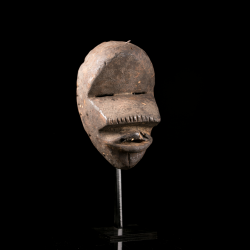
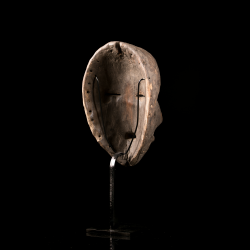
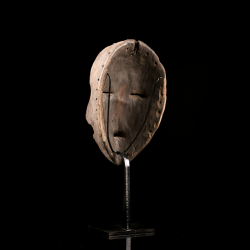
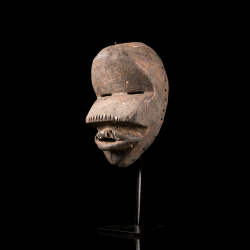
This powerful Dan mask is distinguished by its deliberately forceful modelling: a broad domed forehead, eyes reduced to narrow slits, strongly projecting central facial features and a large mouth carved in pronounced relief. A succession of vertical notches articulates the upper edge of the mouth, while holes around the perimeter indicate the former attachment of a coiffure, beard or elements of the masquerade costume. Its dark surface, matte in places and more polished on the projecting areas, retains a compelling sense of use and age.
In sculptural terms, the mask appears closely related to the Kagle or Kaogle group, forceful male mask personalities within Dan tradition. The Smithsonian characterises Kaogle through its bulging forehead, projecting forms and prominent mouth, while the Metropolitan Museum associates Kagle with the unruly forces of the bush, sometimes linked to the chimpanzee. Its turbulent and provocative performance symbolically tested the strength of social order.
This identification should nevertheless remain probable rather than definitive. Among the Dan, the identity and function of a mask also depended on its costume, choreography and ritual history, elements that are generally lost once a mask leaves its original performance context. Museum scholarship therefore cautions against overly precise classification of an isolated gle.
Data sheet
You might also like
This powerful Dan mask is distinguished by its deliberately forceful modelling: a broad domed forehead, eyes reduced to narrow slits, strongly projecting central facial features and a large mouth carved in pronounced relief. A succession of vertical notches articulates the upper edge of the mouth, while holes around the perimeter indicate the former attachment of a coiffure, beard or elements of the masquerade costume. Its dark surface, matte in places and more polished on the projecting areas, retains a compelling sense of use and age.
In sculptural terms, the mask appears closely related to the Kagle or Kaogle group, forceful male mask personalities within Dan tradition. The Smithsonian characterises Kaogle through its bulging forehead, projecting forms and prominent mouth, while the Metropolitan Museum associates Kagle with the unruly forces of the bush, sometimes linked to the chimpanzee. Its turbulent and provocative performance symbolically tested the strength of social order.
This identification should nevertheless remain probable rather than definitive. Among the Dan, the identity and function of a mask also depended on its costume, choreography and ritual history, elements that are generally lost once a mask leaves its original performance context. Museum scholarship therefore cautions against overly precise classification of an isolated gle.