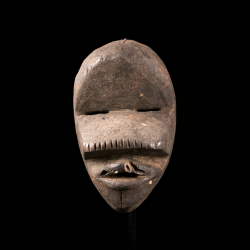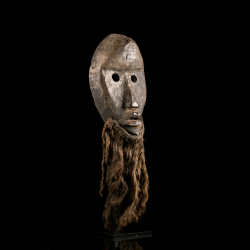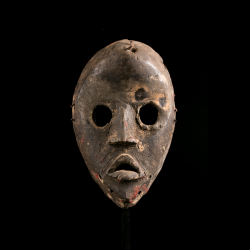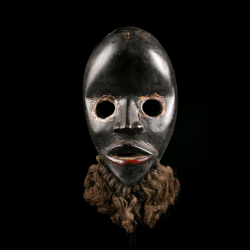
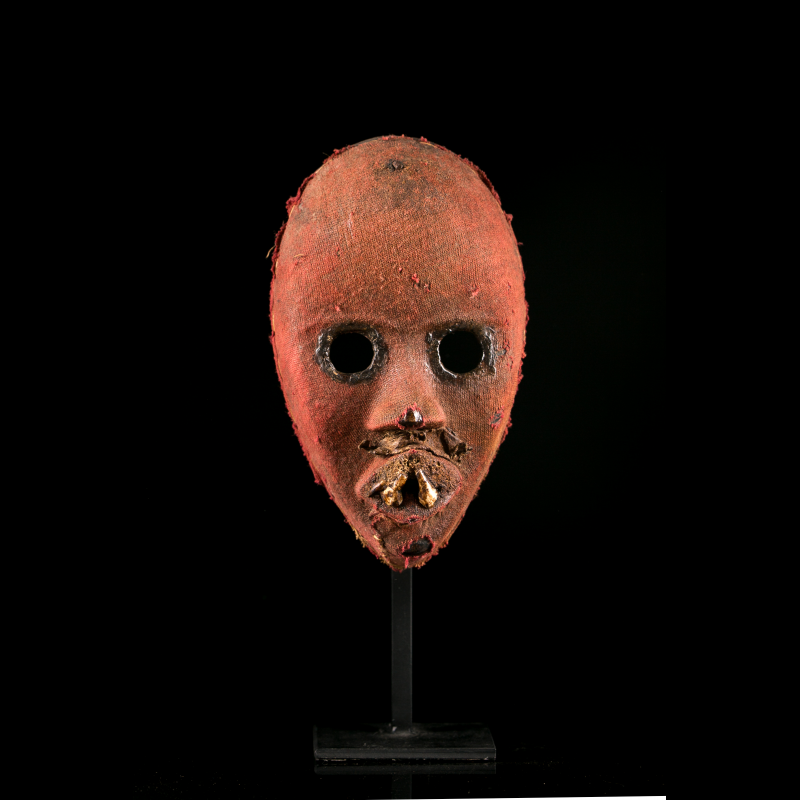


Almost entirely covered with a deeply patinated red cloth, this striking Dan mask immediately stands apart through the strength and simplicity of its appearance. A carved wooden face forms the underlying structure, while the textile covering closely follows its volumes. Large circular eye openings surrounded by a dark material create an unusually intense expression, further reinforced by applied elements surrounding the mouth.
These characteristics strongly support an attribution to the zakpei ge, commonly known as the Dan “fire mask.” In northern Dan communities of western Côte d’Ivoire and neighbouring Liberia, these male masks appeared during the dry season, when they inspected domestic fires and helped enforce precautions against fires spreading through the village. Unlike many other Dan masquerades, the zakpei ge did not dance or sing during these rounds and was accompanied by an assistant carrying a gong.
The Musée du quai Branly specifically identifies round eye openings, red paint or red cloth coverings, and occasional beards or moustaches among the distinguishing features associated with this mask type. These elements correspond particularly well with the present example.
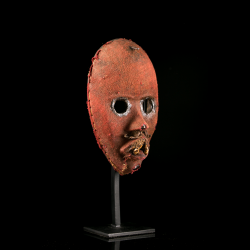
Its visual impact comes from an unusual combination of materials. The muted red textile contrasts dramatically with the blackened eye rims, while the applied components around the mouth introduce a rough, organic dimension. Seen from the reverse, the carved wooden structure and functional openings remain clearly visible beneath the textile covering.
Dan masquerade objects could incorporate a remarkably broad range of materials beyond carved wood; museum collections document examples combining cloth, fibre, animal materials, iron and pigment. Here, this material complexity contributes to a mask whose presence is both austere and highly expressive.
Data sheet
You might also like
Almost entirely covered with a deeply patinated red cloth, this striking Dan mask immediately stands apart through the strength and simplicity of its appearance. A carved wooden face forms the underlying structure, while the textile covering closely follows its volumes. Large circular eye openings surrounded by a dark material create an unusually intense expression, further reinforced by applied elements surrounding the mouth.
These characteristics strongly support an attribution to the zakpei ge, commonly known as the Dan “fire mask.” In northern Dan communities of western Côte d’Ivoire and neighbouring Liberia, these male masks appeared during the dry season, when they inspected domestic fires and helped enforce precautions against fires spreading through the village. Unlike many other Dan masquerades, the zakpei ge did not dance or sing during these rounds and was accompanied by an assistant carrying a gong.
The Musée du quai Branly specifically identifies round eye openings, red paint or red cloth coverings, and occasional beards or moustaches among the distinguishing features associated with this mask type. These elements correspond particularly well with the present example.
Its visual impact comes from an unusual combination of materials. The muted red textile contrasts dramatically with the blackened eye rims, while the applied components around the mouth introduce a rough, organic dimension. Seen from the reverse, the carved wooden structure and functional openings remain clearly visible beneath the textile covering.
Dan masquerade objects could incorporate a remarkably broad range of materials beyond carved wood; museum collections document examples combining cloth, fibre, animal materials, iron and pigment. Here, this material complexity contributes to a mask whose presence is both austere and highly expressive.