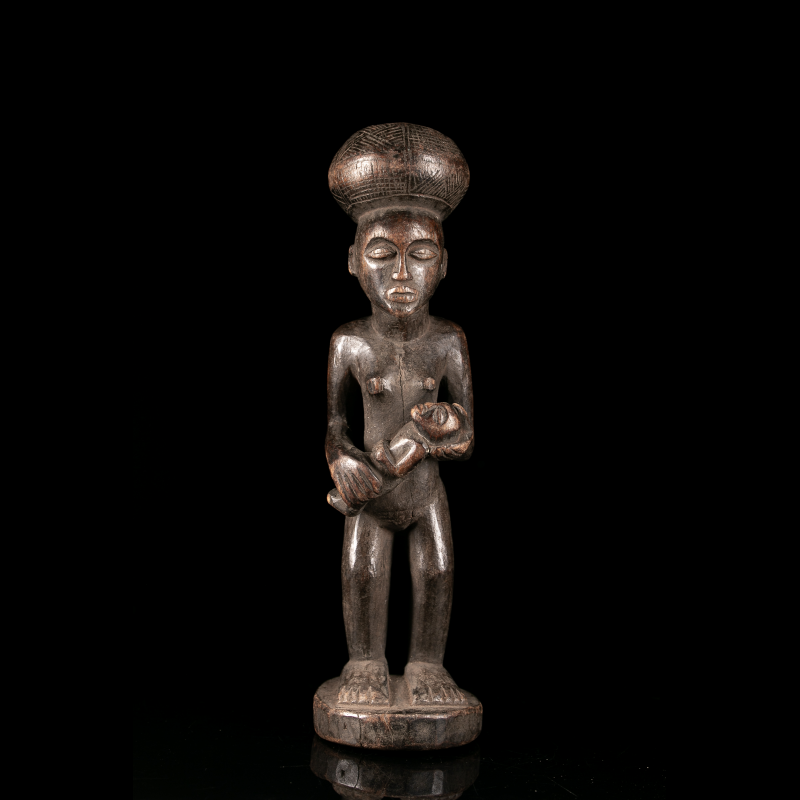
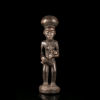
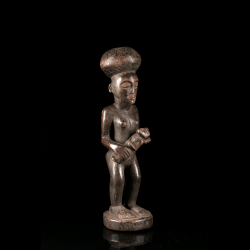

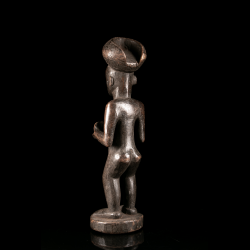
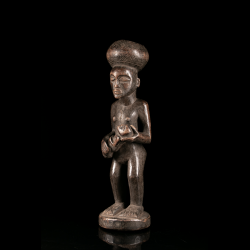
Elegant Chokwe-Lwena maternity figure carved in wood, depicting a standing woman holding a child across her lower torso. The composition combines the calm vertical presence of the mother with the more intimate gesture of the infant cradled horizontally in her arms.
The face is sensitively restrained, with narrow almond-shaped eyes, a straight nose, slightly parted lips and balanced facial planes. The most striking feature is the large rounded coiffure, extensively decorated with fine geometric incisions. This cushion-like hairstyle is particularly relevant to the attribution: the Smithsonian National Museum of African Art identifies such coiffures as a characteristic feature of the classic Lwena sculptural style of the Angola-Zambia region.
The designation Chokwe-Lwena, or Chokwe-Luena, therefore seems appropriate for this work. Artistic boundaries between these neighbouring populations were fluid. The Metropolitan Museum itself catalogues certain female sculptures cautiously as “Chokwe or Lwena (?)”, while museum research also documents the circulation of stylistic features between Chokwe and Lwena artists.
The child gives the sculpture its principal iconographic focus. Chokwe society traditionally traces descent through the maternal line, giving female ancestors and ideals of womanhood an important position within its visual culture. The Metropolitan Museum emphasizes this matrilineal dimension in its discussions of Chokwe female imagery and commemorative sculpture. A Chokwe prestige stool in the Met collection incorporating a mother-and-child caryatid further demonstrates the place of maternity imagery within Chokwe artistic traditions.
Data sheet
You might also like
Elegant Chokwe-Lwena maternity figure carved in wood, depicting a standing woman holding a child across her lower torso. The composition combines the calm vertical presence of the mother with the more intimate gesture of the infant cradled horizontally in her arms.
The face is sensitively restrained, with narrow almond-shaped eyes, a straight nose, slightly parted lips and balanced facial planes. The most striking feature is the large rounded coiffure, extensively decorated with fine geometric incisions. This cushion-like hairstyle is particularly relevant to the attribution: the Smithsonian National Museum of African Art identifies such coiffures as a characteristic feature of the classic Lwena sculptural style of the Angola-Zambia region.
The designation Chokwe-Lwena, or Chokwe-Luena, therefore seems appropriate for this work. Artistic boundaries between these neighbouring populations were fluid. The Metropolitan Museum itself catalogues certain female sculptures cautiously as “Chokwe or Lwena (?)”, while museum research also documents the circulation of stylistic features between Chokwe and Lwena artists.
The child gives the sculpture its principal iconographic focus. Chokwe society traditionally traces descent through the maternal line, giving female ancestors and ideals of womanhood an important position within its visual culture. The Metropolitan Museum emphasizes this matrilineal dimension in its discussions of Chokwe female imagery and commemorative sculpture. A Chokwe prestige stool in the Met collection incorporating a mother-and-child caryatid further demonstrates the place of maternity imagery within Chokwe artistic traditions.