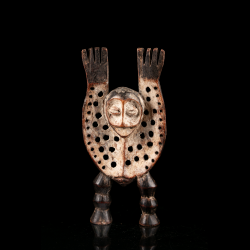
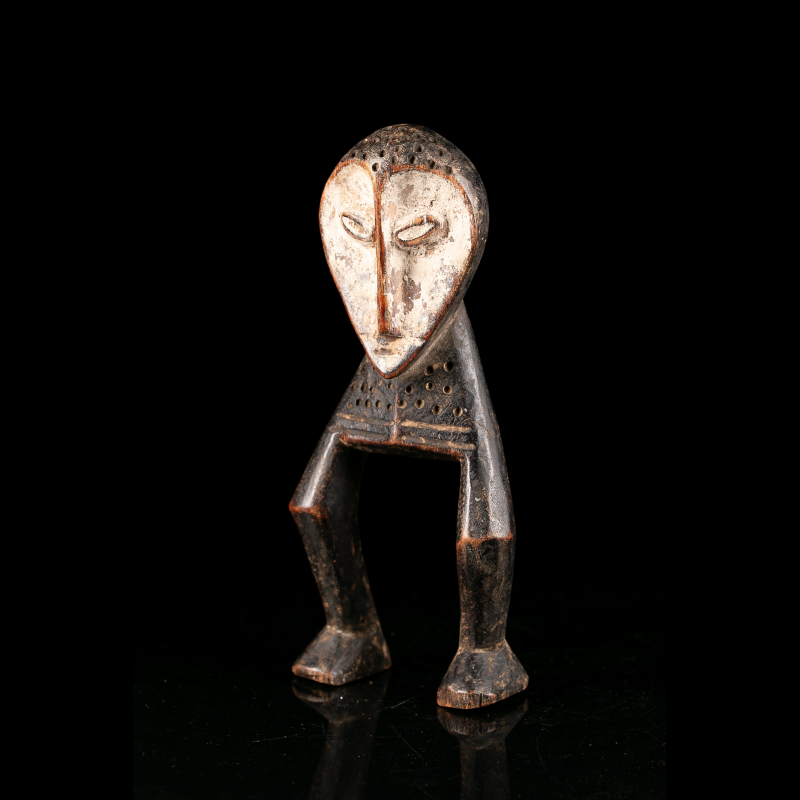
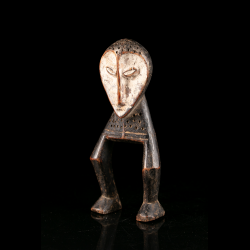
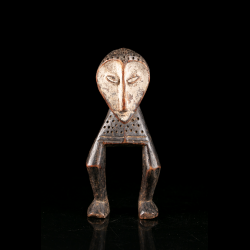
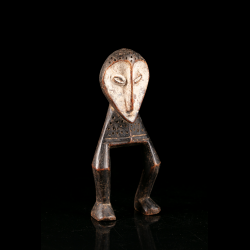
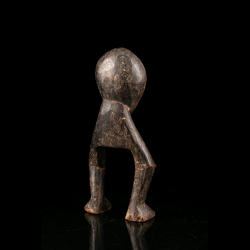
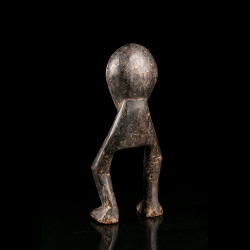
This Lega anthropomorphic figure belongs to the broad corpus of objects associated with Bwami, the initiatory institution that structured the moral and social life of Lega communities in eastern Democratic Republic of the Congo. The sculpture is distinguished by its deliberately reduced construction: two long, arched legs support a highly simplified torso dominated by a broad heart-shaped face covered with a pale pigment. The narrow eyes, long axial nose and overall economy of form correspond closely to the visual vocabulary found in many Lega works.
The numerous perforations visible on the upper part of the body suggest a connection with figures known as katanda, a term referring to a sleeping mat. In certain Bwami teachings, a pierced or damaged mat becomes a metaphor for negligence, disorder, or the consequences of behaviour contrary to collective values. The contrast between the whitened face—traditionally associated in Lega art with ideas of clarity, distinction or initiatory transformation—and the dark body strengthens the graphic presence of the sculpture. Surface wear, abrasions and irregularities contribute fully to its sense of age and ritual character.
Lega art cannot be understood independently of Bwami, a hierarchical initiatory association in which successive ranks corresponded to moral, social and spiritual advancement. Sculptures, masks and other objects presented during initiation were not merely representational images: they served as visual supports for proverbs, narratives, songs and demonstrations through which ethical principles were transmitted.
The attribution of this sculpture to the katanda type is based primarily on its highly schematised, perforated body and pale face. In the literature devoted to Lega art, certain katanda figures are associated with the image of a damaged sleeping mat, used as a metaphor for the consequences of negligence or misconduct. Some caution nevertheless remains necessary, as Bwami objects were deliberately polyvalent and their meaning could change according to the initiate’s rank, the circumstances in which the object was displayed and the proverb associated with it.
Former collection of Aimé-Lucien Mbungu Mbuka, Galerie Antika, Kinshasa, Democratic Republic of the Congo.
Aimé-Lucien Mbungu Mbuka is a recognised figure in the field of Congolese traditional arts in Kinshasa and has directed Galerie Antika, an institution involved in the presentation and preservation of works from various cultural groups of the Democratic Republic of the Congo.
Data sheet
You might also like
This Lega anthropomorphic figure belongs to the broad corpus of objects associated with Bwami, the initiatory institution that structured the moral and social life of Lega communities in eastern Democratic Republic of the Congo. The sculpture is distinguished by its deliberately reduced construction: two long, arched legs support a highly simplified torso dominated by a broad heart-shaped face covered with a pale pigment. The narrow eyes, long axial nose and overall economy of form correspond closely to the visual vocabulary found in many Lega works.
The numerous perforations visible on the upper part of the body suggest a connection with figures known as katanda, a term referring to a sleeping mat. In certain Bwami teachings, a pierced or damaged mat becomes a metaphor for negligence, disorder, or the consequences of behaviour contrary to collective values. The contrast between the whitened face—traditionally associated in Lega art with ideas of clarity, distinction or initiatory transformation—and the dark body strengthens the graphic presence of the sculpture. Surface wear, abrasions and irregularities contribute fully to its sense of age and ritual character.
Lega art cannot be understood independently of Bwami, a hierarchical initiatory association in which successive ranks corresponded to moral, social and spiritual advancement. Sculptures, masks and other objects presented during initiation were not merely representational images: they served as visual supports for proverbs, narratives, songs and demonstrations through which ethical principles were transmitted.
The attribution of this sculpture to the katanda type is based primarily on its highly schematised, perforated body and pale face. In the literature devoted to Lega art, certain katanda figures are associated with the image of a damaged sleeping mat, used as a metaphor for the consequences of negligence or misconduct. Some caution nevertheless remains necessary, as Bwami objects were deliberately polyvalent and their meaning could change according to the initiate’s rank, the circumstances in which the object was displayed and the proverb associated with it.
Former collection of Aimé-Lucien Mbungu Mbuka, Galerie Antika, Kinshasa, Democratic Republic of the Congo.
Aimé-Lucien Mbungu Mbuka is a recognised figure in the field of Congolese traditional arts in Kinshasa and has directed Galerie Antika, an institution involved in the presentation and preservation of works from various cultural groups of the Democratic Republic of the Congo.