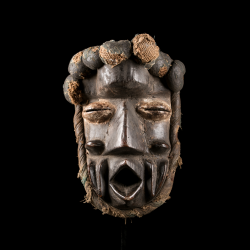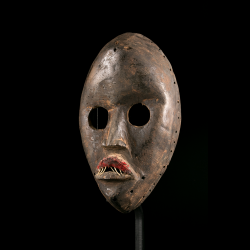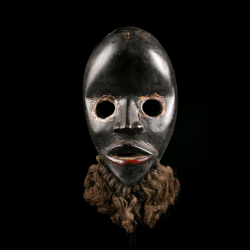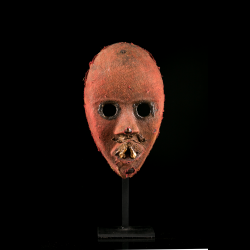
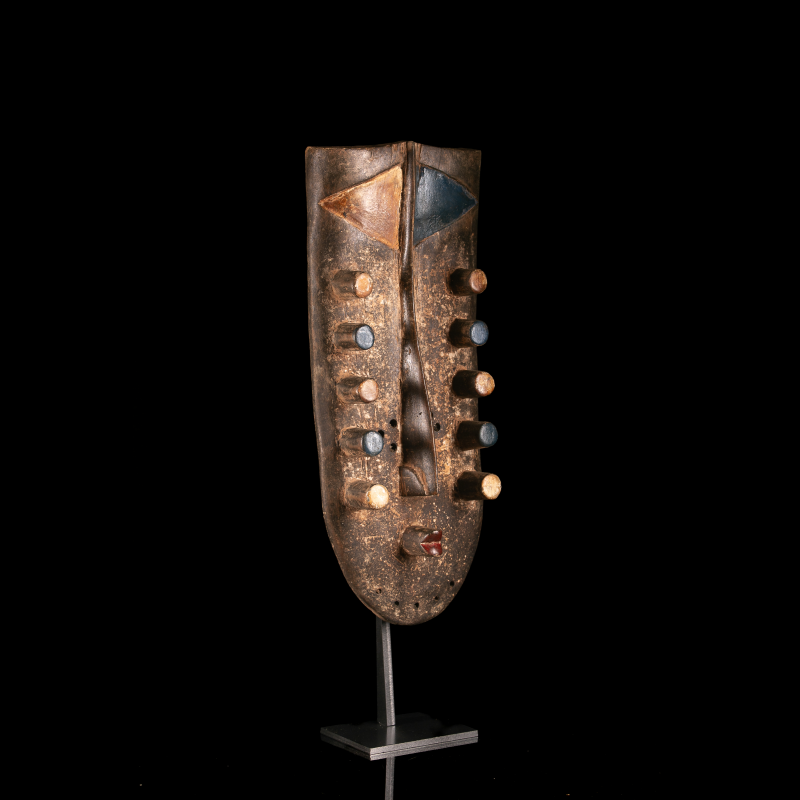
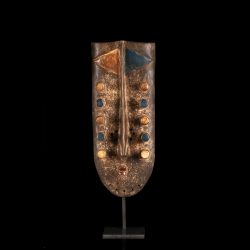
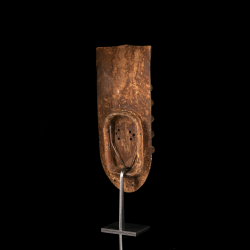
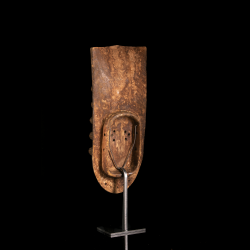
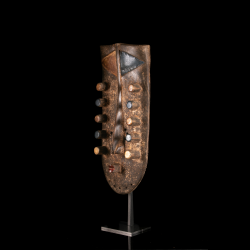
Striking Grebo-Kru mask conceived in a strongly geometric idiom and carved from a thick, slightly concave wooden plank. Its composition is dominated by a long central nasal ridge and ten symmetrically arranged cylindrical projections, alternately highlighted with ochre and blue-black pigments.
Two large coloured triangular fields structure the forehead, while a small projecting mouth retaining red pigment animates the lower section. Perforations around the face were most likely used to attach elements of the masquerade costume.
This sculptural language belongs to the celebrated tradition of masks commonly identified as Grebo, Kru or formerly “Sassandra” masks, originating between southeastern Liberia and southwestern Côte d’Ivoire. The Musée du quai Branly notes that precise ethnic attribution remains complex, as related forms circulated among several Kru-speaking peoples.
The projecting eyes characteristic of this tradition have been interpreted as expressing heightened vision or an all-seeing capacity. The Metropolitan Museum also associates them, in certain Kru contexts, with the heightened perception of the ideal warrior. Their roles nevertheless varied between communities and could include initiation, funerary, judicial and male-association contexts.
The radical construction of these masks — flat planes, projecting volumes and near-abstract geometry — contributed to the powerful impression they made on early twentieth-century European modernists.
Custom-made high-end display stand included, providing a gallery-quality presentation.
Data sheet
You might also like
Striking Grebo-Kru mask conceived in a strongly geometric idiom and carved from a thick, slightly concave wooden plank. Its composition is dominated by a long central nasal ridge and ten symmetrically arranged cylindrical projections, alternately highlighted with ochre and blue-black pigments.
Two large coloured triangular fields structure the forehead, while a small projecting mouth retaining red pigment animates the lower section. Perforations around the face were most likely used to attach elements of the masquerade costume.
This sculptural language belongs to the celebrated tradition of masks commonly identified as Grebo, Kru or formerly “Sassandra” masks, originating between southeastern Liberia and southwestern Côte d’Ivoire. The Musée du quai Branly notes that precise ethnic attribution remains complex, as related forms circulated among several Kru-speaking peoples.
The projecting eyes characteristic of this tradition have been interpreted as expressing heightened vision or an all-seeing capacity. The Metropolitan Museum also associates them, in certain Kru contexts, with the heightened perception of the ideal warrior. Their roles nevertheless varied between communities and could include initiation, funerary, judicial and male-association contexts.
The radical construction of these masks — flat planes, projecting volumes and near-abstract geometry — contributed to the powerful impression they made on early twentieth-century European modernists.
Custom-made high-end display stand included, providing a gallery-quality presentation.